Email marketing delivers an average return of $36 to $42 for every dollar spent. That is a 3,600% to 4,200% ROI, consistently outperforming paid search, social media advertising, and display ads.
Yet most businesses struggle with email marketing. Not because the channel does not work, but because they lack a system for planning, executing, and optimizing their campaigns.
This email marketing guide covers everything you need to build a profitable email marketing operation in 2026: strategy fundamentals, the right tools, campaign planning, performance tracking, and free templates to get started immediately.
Table of Contents
What You’ll Learn
What Is Email Marketing?
Email marketing is the practice of sending targeted messages to a list of subscribers who have opted in to hear from you. Unlike social media where algorithms decide who sees your content, email gives you direct access to your audience’s inbox.
The core types of email marketing:
Newsletters — regular value-driven content that builds trust and keeps your brand top of mind
Email marketing conversion rate of 2.4-2.8% — higher than social media (0.7%) and display ads (0.3%)
51% of consumers prefer to be contacted by brands via email over any other channel
42% of emails are opened on mobile devices — your audience reads everywhere
Why Email Outperforms Other Channels
You own your audience. Social media platforms change algorithms constantly. Email subscribers are yours. No algorithm decides whether they see your message.
It scales without proportional cost. Sending to 10,000 subscribers costs marginally more than sending to 1,000. Try that with paid advertising.
It works for every business model. E-commerce, SaaS, consulting, content creation, coaching — email drives revenue across all of them.
It compounds over time. Every subscriber you add increases the value of every future campaign. A list of 5,000 engaged subscribers is a permanent business asset.
Building Your Email Marketing Strategy
A strategy is not “send a newsletter every week.” A strategy answers: who are you emailing, why, what will you send, and how will you measure success?
Step 1: Define Your Goals
Every email program needs clear objectives. Common goals include:
Drive revenue — direct sales from promotional campaigns and funnels
Nurture leads — move prospects closer to a buying decision
Build authority — position yourself as an expert through valuable content
Retain customers — keep existing buyers engaged and coming back
Grow your list — attract new subscribers through lead magnets and content
Pick 1-2 primary goals. Trying to do everything at once dilutes your effectiveness.
Step 2: Know Your Audience
Effective email marketing starts with understanding who you are writing to:
Demographics — age, location, job title, industry
Pain points — what problems are they trying to solve?
Buying stage — are they researching, comparing options, or ready to buy?
Content preferences — do they prefer short tips, long guides, case studies, or tools?
Segmentation is the key differentiator. Personalized, segmented emails generate 6x higher conversion rates than generic blasts.
Step 3: Plan Your Content Mix
The 80/20 rule is the foundation of sustainable email marketing:
80% value content — tips, insights, stories, resources, educational material
20% promotional content — product launches, sales, offers, direct CTAs
This balance keeps subscribers engaged without feeling like they are constantly being sold to. Violate it, and watch your unsubscribe rates climb.
Teaser → launch → features → social proof → last chance
Consistency matters more than frequency. One email per week, every week, builds more trust than five emails one week and silence the next.
Step 5: Build Your Email Calendar
An email marketing calendar transforms your strategy from ideas into scheduled actions. It shows what to send, when to send it, and how each email connects to your goals.
Your email marketing stack has two layers: a sending platform (ESP) and a planning system.
Email Service Providers (ESPs)
These are the platforms that actually send your emails and manage your subscriber list:
For beginners and solopreneurs:
Mailchimp: the most recognized name, generous free tier (500 contacts), drag-and-drop editor, basic automation. Best for: first-time email marketers.
MailerLite: clean interface, excellent free plan (1,000 subscribers), landing pages included. Best for: creators who want simplicity.
Sender: very generous free tier (2,500 subscribers, 15,000 emails/month), built-in SMS. Best for: budget-conscious businesses.
For growing businesses:
KIT (formerly ConvertKit): built for creators, visual automations, tag-based system instead of lists, commerce features. Best for: bloggers, podcasters, course creators.
Brevo (formerly Sendinblue): email + SMS + chat in one platform, pay by emails sent not contacts. Best for: businesses that want multi-channel.
ActiveCampaign: powerful automation, CRM built-in, advanced segmentation. Best for: businesses ready for sophisticated workflows.
For advanced teams:
HubSpot: full marketing suite with email, CRM, landing pages, analytics. Best for: B2B companies with bigger budgets.
Klaviyo: e-commerce focused, deep Shopify/WooCommerce integration, predictive analytics. Best for: online stores.
Mautic: open-source, self-hosted, fully customizable. Best for: technical teams who want complete control.
How to Choose
Ask these questions:
How many subscribers do you have? — this determines which free tiers work for you
Do you need automation? — simple broadcasts vs. multi-step sequences
What integrations matter? — Shopify, WordPress, Gumroad, etc.
What is your budget? — free tools exist, but paid plans unlock critical features
Do you need landing pages? — some ESPs include them, others require separate tools
The Planning Layer
Your ESP sends the emails. But where do you plan them? Where do you map out your calendar, track ideas, organize content, and review performance?
This is where most email marketers fall short. They jump into their ESP and start writing without a plan, leading to inconsistent sends, repetitive content, and zero performance tracking.
Your subject line determines whether your email gets read or ignored. In 2026, the average email open rate across industries is around 42%, but this varies dramatically based on subject line quality.
What works:
Curiosity gaps — “The one change that doubled my conversion rate”
Specificity — “5 tools, 3 minutes, zero cost”
Personalization — using the subscriber’s name or referencing their behavior
Questions — “Are you making this email marketing mistake?”
Numbers and lists — “7 subject line formulas that get 40%+ open rates”
What to avoid:
ALL CAPS or excessive punctuation (triggers spam filters)
Misleading promises (destroys trust)
Generic subjects like “Newsletter #47” (no reason to open)
Overly long subjects — keep under 50 characters for mobile optimization
Email Body Best Practices
Structure for readability:
Lead with the most valuable point — do not bury the hook
Use short paragraphs (2-3 sentences maximum)
Include subheadings for emails longer than 200 words
One clear call-to-action per email
Mobile-first design — over 42% of opens happen on phones
Content that converts:
Tell stories that illustrate your points
Use social proof (testimonials, case studies, numbers)
Create urgency when appropriate (deadlines, limited availability)
Always provide value before asking for action
Welcome Sequences
The welcome sequence is your most important automated email series. New subscribers are at peak interest — their open rates are highest in the first 24-48 hours.
A proven 5-email welcome structure:
Email 1 (Day 0): Deliver the lead magnet + set expectations for future emails
Email 2 (Day 2): Share your best tip or resource — build trust immediately
Email 3 (Day 4): Tell your story — why you do what you do
Email 4 (Day 7): Soft pitch — introduce your product as a natural next step
Email 5 (Day 10): Direct offer with urgency — discount, bonus, or deadline
This sequence alone can generate significant revenue on autopilot.
Sales Funnels
A sales funnel is a multi-step email sequence designed to move subscribers from awareness to purchase. Unlike one-off promotional emails, funnels nurture the relationship over days or weeks.
Key funnel elements:
Entry point — how subscribers enter the funnel (lead magnet, webinar, free trial)
Nurture phase — emails that build trust and demonstrate value
Conversion phase — emails that present the offer with social proof and urgency
Follow-up — post-purchase onboarding or re-engagement for non-buyers
Measuring Email Marketing Performance
Tracking the right metrics is what separates strategic email marketers from those who are just “sending emails.”
Key Metrics to Track
Metric
What It Measures
2026 Benchmark
Why It Matters
Open rate
% who opened your email
30-42% (varies by industry)
Subject line effectiveness + list health
Click-through rate (CTR)
% who clicked a link
2-5%
Content relevance + CTA strength
Conversion rate
% who completed the desired action
2-5%
Overall campaign effectiveness
Unsubscribe rate
% who opted out
Below 0.5% per send
Content-audience fit + sending frequency
Bounce rate
% of undelivered emails
Below 2%
List hygiene + data quality
Revenue per email (RPE)
Revenue generated per email sent
Varies widely
Direct business impact measurement
How to Use Your Data
Weekly review (10 minutes):
Check open rates — are subject lines working?
Review CTR — is content driving action?
Monitor unsubscribes — are you over-sending?
Monthly review (30 minutes):
Compare metrics across campaigns — which types perform best?
Basic personalization (“Hi [Name]”) is table stakes. In 2026, AI enables:
Predictive send time optimization — emails arrive when each subscriber is most likely to open
Dynamic content blocks — different content shown to different segments within the same email
AI-generated subject lines — tested and optimized automatically
Behavioral triggers — emails sent based on website activity, purchase history, or engagement patterns
2. Privacy-First Email Marketing
With Apple’s Mail Privacy Protection and evolving regulations (GDPR, CAN-SPAM), privacy is reshaping email:
Open rate tracking is becoming less reliable — focus on clicks and conversions instead
First-party data (data you collect directly) is more valuable than ever
Explicit consent and easy unsubscribe options are non-negotiable
Double opt-in is becoming the standard for quality lists
3. Interactive Email Content
Embedded polls, surveys, and quizzes directly in the email
Accordion menus and expandable content sections
Add-to-cart buttons within the email (no redirect needed)
Live countdown timers for promotions
4. Automation as the Default
In 2026, the strongest email programs are built as systems that run continuously, not isolated campaigns:
Welcome sequences that educate over time
Post-purchase follow-ups that drive repeat business
Re-engagement flows that win back inactive subscribers
Evergreen content that stays relevant for months
Email Deliverability: Getting Into the Inbox
The best email in the world is useless if it lands in spam. Deliverability is the foundation everything else depends on.
Essential Deliverability Practices
Authenticate your domain — set up SPF, DKIM, and DMARC records
Use a consistent sending address — do not change your “from” email frequently
Warm up new domains gradually — start with small sends and increase over weeks
Clean your list regularly — remove bounced addresses, inactive subscribers, and duplicates
Make unsubscribing easy — a visible unsubscribe link reduces spam complaints
Monitor your sender reputation — use tools like Google Postmaster to check your domain health
List Hygiene Schedule
After every send: Remove hard bounces immediately
Monthly: Review subscribers with zero opens in 90 days
Quarterly: Run a re-engagement campaign for inactive subscribers, then remove non-responders
Annually: Full list audit — verify email addresses and update segments
Getting Started: Free Templates and Tools
If this email marketing guide feels like a lot to implement at once, start with the right system. Having a planning template eliminates the “where do I begin” paralysis.
Email Marketing Mini Planner (Free)
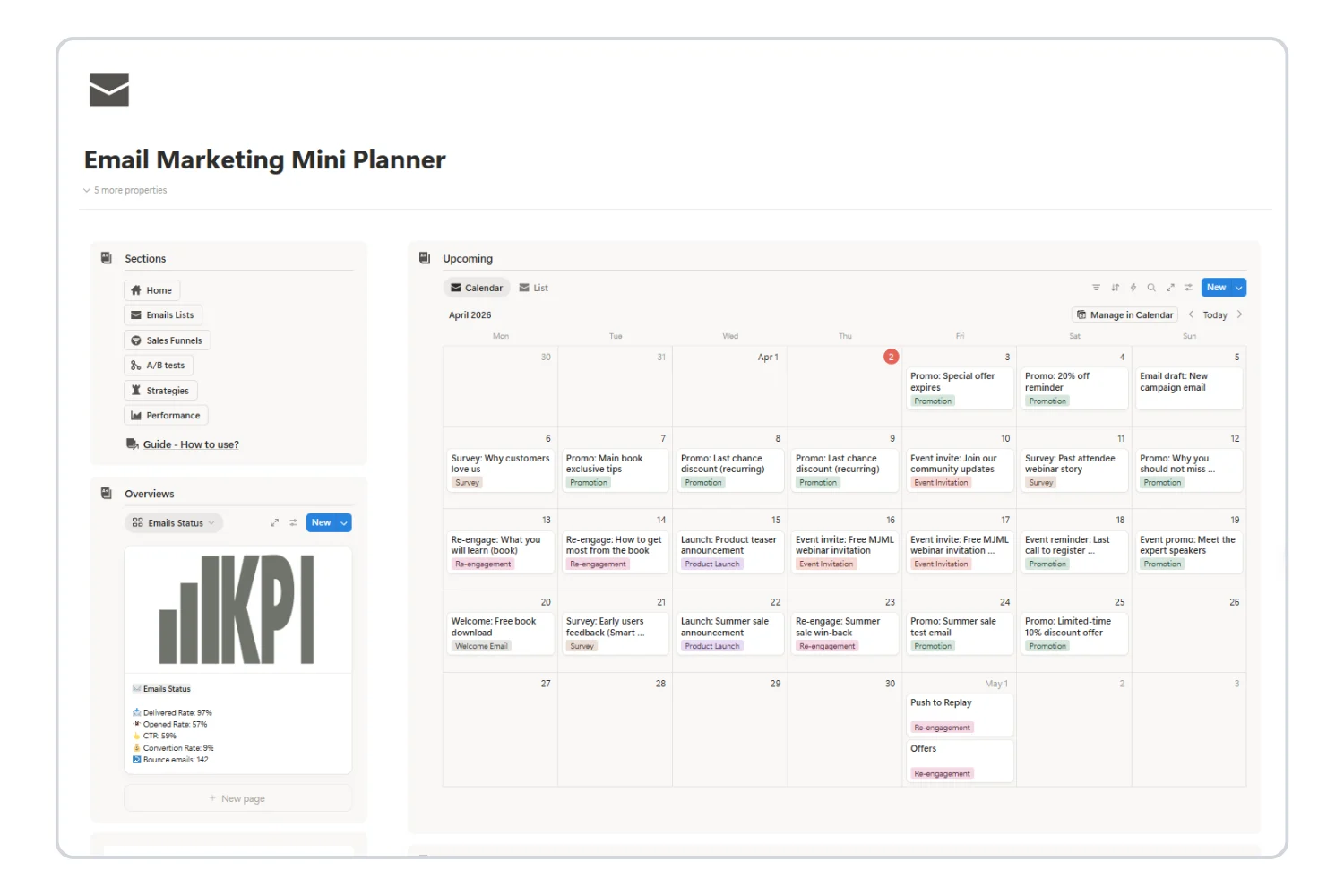
The Email Marketing Mini Planner is a free Notion template that gives you:
Emails List database with calendar view for visual scheduling
Analytics tracking for open rates, CTR, and key metrics
Status workflow (Draft → Scheduled → Sent → Archived)
Built-in guide with setup instructions
Perfect for solopreneurs and creators who want to start organized from day one.
Calendar setup with examples: How to Create an Email Marketing Calendar in 2026 (with Notion Template)
Template comparison: Free Email Marketing Calendar Template for Notion to Organize Campaigns
Frequently Asked Questions
Is email marketing still effective in 2026?
Yes. Email remains the highest ROI marketing channel at $36-$42 per dollar spent. With 4.5 billion users and direct inbox access (no algorithm interference), email outperforms social media and paid advertising for most businesses.
How do I start email marketing with zero subscribers?
Create a lead magnet (free guide, template, checklist), set up a landing page, promote it on social media and relevant communities, and use a free ESP like Sender or MailerLite to manage your list.
How often should I email my list?
Start with once per week. Consistency matters more than frequency. Increase only when you can maintain quality and your metrics support it.
What is a good open rate?
A good open rate in 2026 is above 30%, with 42% being the cross-industry average. Rates above 45% are considered strong, and above 50% is exceptional.
Do I need to pay for email marketing tools?
Not initially. Many ESPs offer generous free tiers (Sender: 2,500 subscribers, MailerLite: 1,000 subscribers, Mailchimp: 500 subscribers). Start free and upgrade when your list grows.
How do I avoid the spam folder?
Authenticate your domain (SPF, DKIM, DMARC), maintain list hygiene, send consistently, avoid spam trigger words, and make it easy to unsubscribe.
Start Building Your Email Marketing System
Email marketing is not complicated. It is a system: plan, send, track, improve, repeat.
Here is your action plan:
Choose your ESP — start with a free tier that fits your needs
Set up your planning system — use the free Mini Planner or a simple spreadsheet
Define your strategy — goals, audience, content mix, and cadence
Build your calendar — plan your first month of emails
Create a welcome sequence — automate the first impression
Send consistently — the hardest part is starting
Track and optimize — review metrics weekly, adjust monthly
The businesses that win at email marketing are not the ones with the biggest budgets. They are the ones with the best systems.
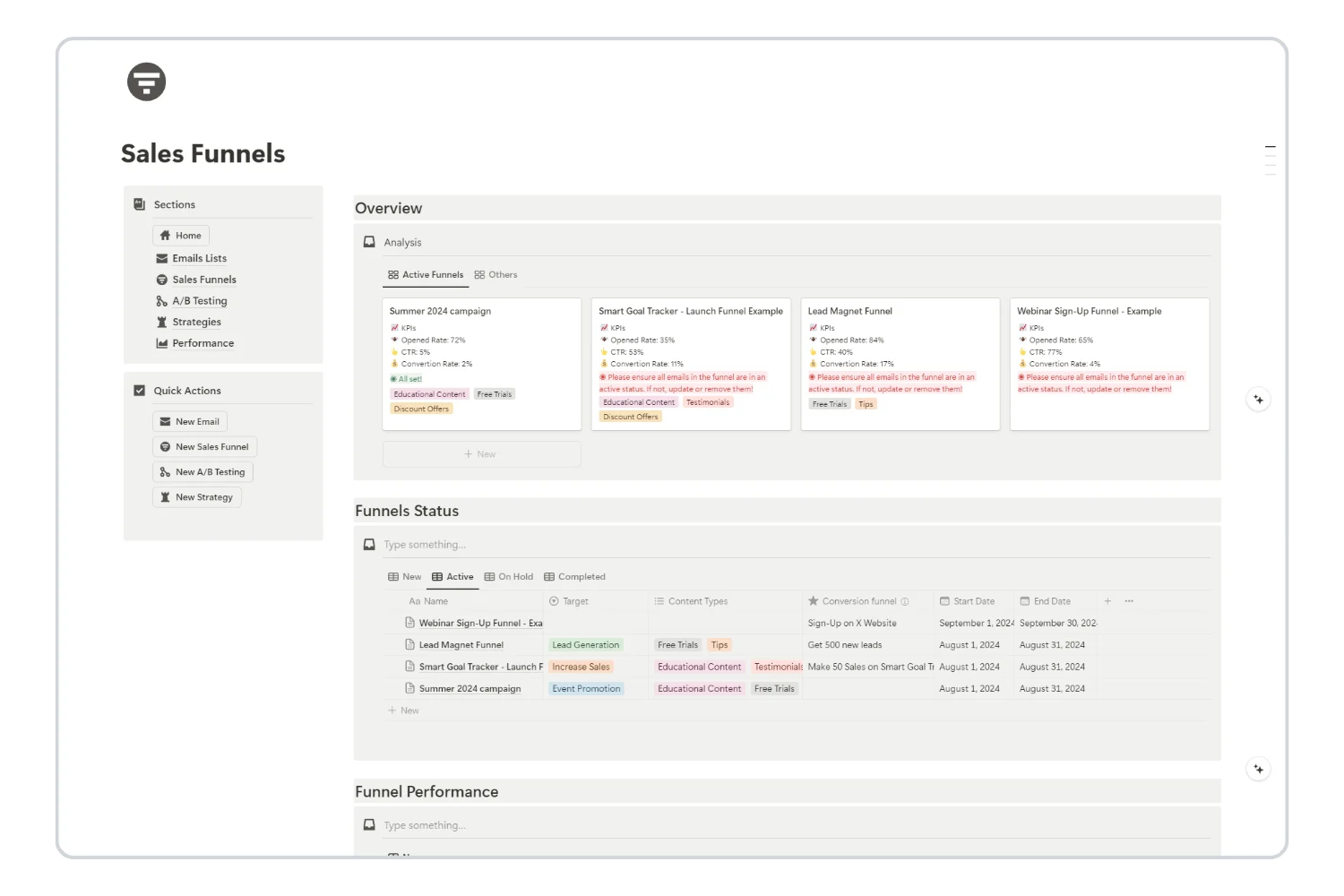
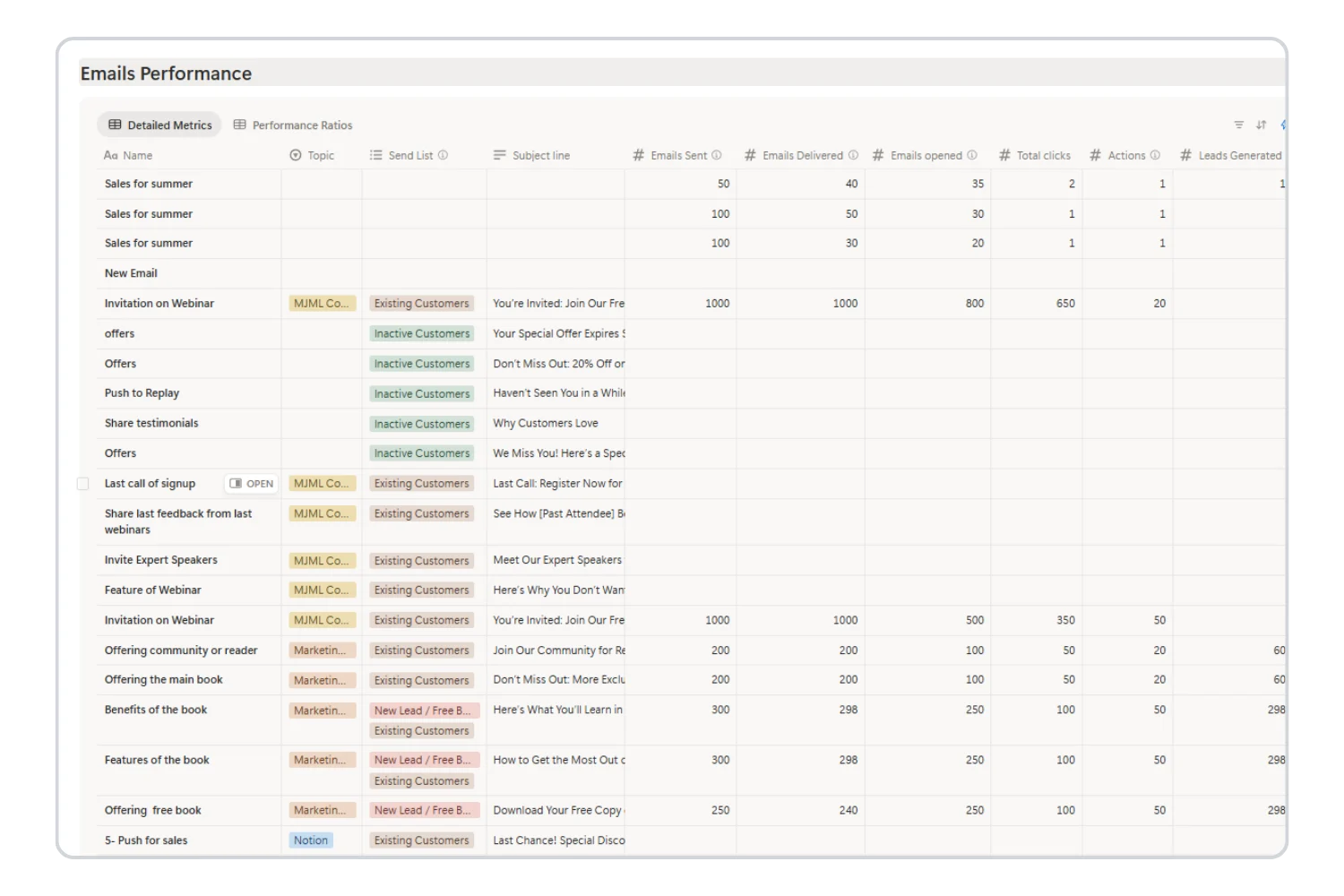
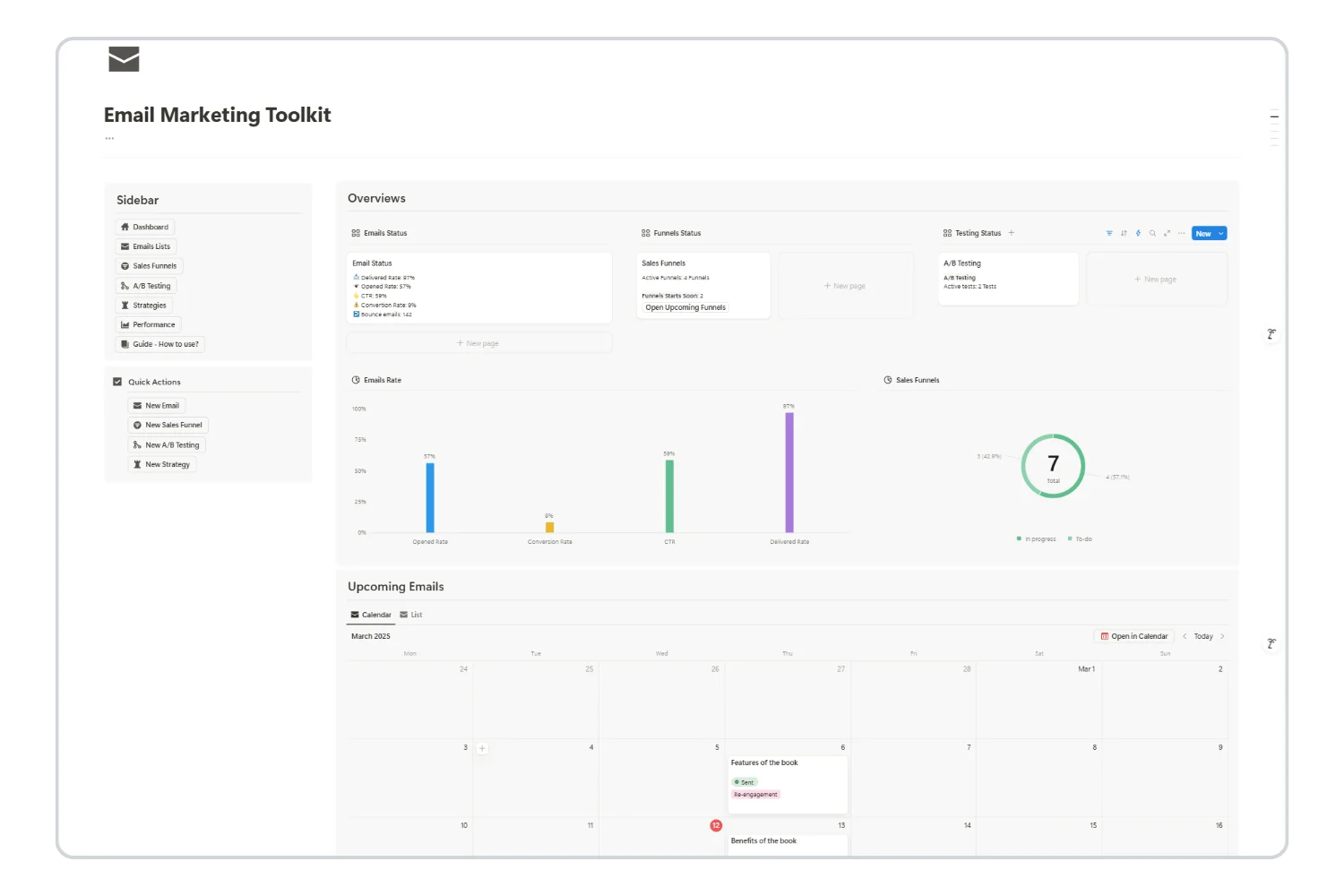
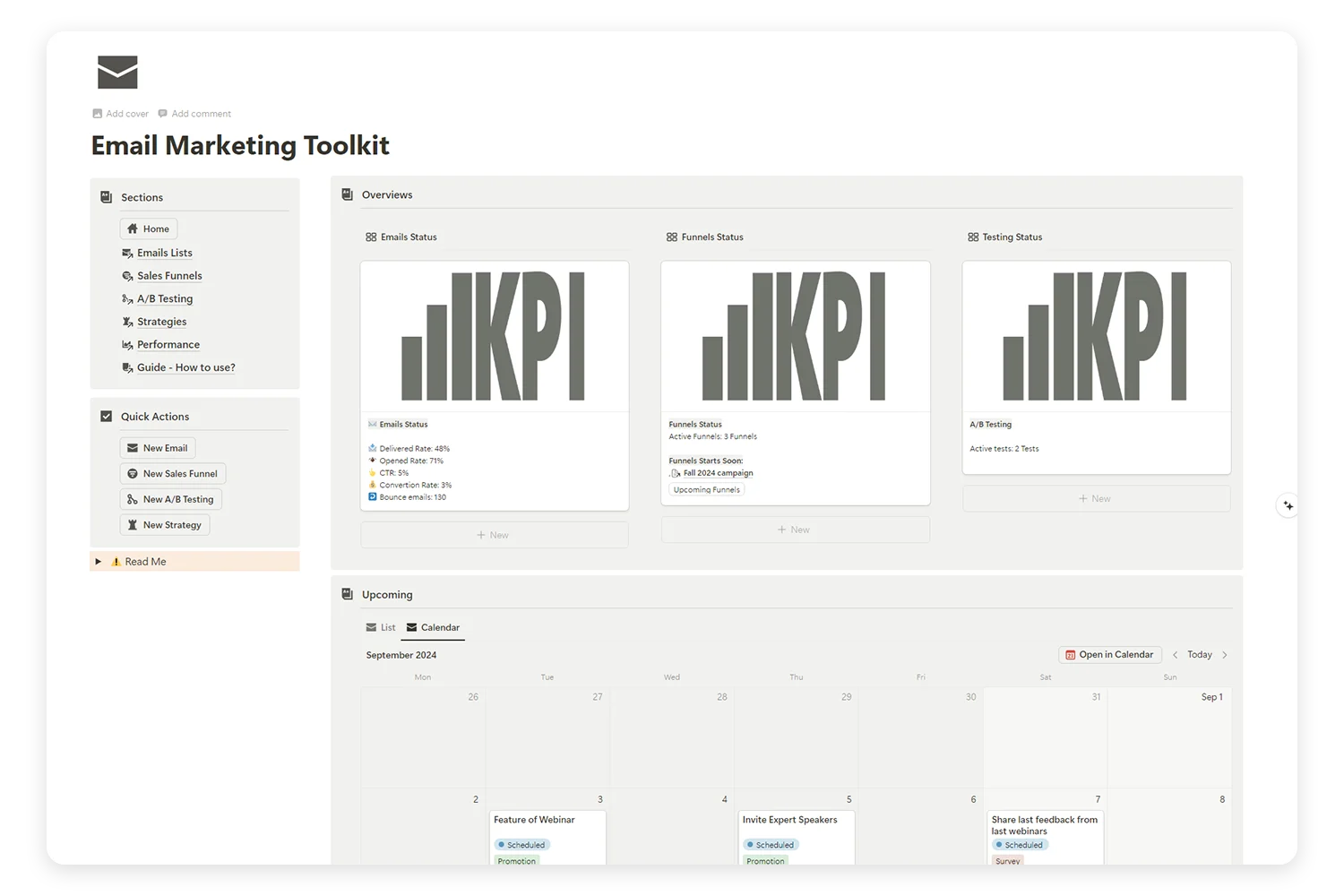
Supercharge Your Email Marketing with the Ultimate Toolkit!
Tired of juggling multiple platforms to manage your email campaigns, sales funnels, and A/B tests? Our Email Marketing Toolkit is here to organize, analyze, and optimize your email strategies—all in one place.