

Last updated on May 19th, 2026 at 03:43 pm
A 50% commission means nothing without traffic, conversion, and retention. Most affiliate marketers stare at the headline rate and miss the number that pays the rent. High-paying affiliate programs look profitable on the application page and lose money in the spreadsheet 60 days later.
High-paying programs hide three traps. Long sales cycles drain attention. Refund-heavy products cancel commissions weeks after the click. Custom-attribution models let the brand win disputes you should win.
This article walks digital marketers through affiliate marketing ROI from the four inputs up. Affiliate program profitability reduces to four numbers, and the same math applies whether you promote a $19 ebook or a $2,000 SaaS subscription. The framework treats every program as a small business: revenue per visitor, cost per click, time invested per dollar earned.
By the end, you will have:
- The 4 inputs that decide ROI on every affiliate offer
- Benchmarks by program tier so you know what good looks like
- A 30-day ROI test with breakeven math and cross-checks
Table of Contents
What You’ll Learn
The 4 inputs that decide affiliate ROI: EPC, AOV, conversion rate, refund rate
Every affiliate program reduces to four numbers. Get them wrong and the headline commission lies to you.
1. EPC, earnings per click
EPC, the standard earnings per click affiliate networks track, is the average dollar amount earned per click across all affiliates in the program. Networks like Impact, ShareASale, and PartnerStack publish EPC benchmarks openly. Independent affiliate programs hide them.
Calculate yours: total commissions divided by total clicks.
Benchmarks:
- Above $1.50 EPC → top quartile
- $0.75 to $1.49 → strong
- $0.30 to $0.74 → average
- Under $0.30 → weak, drops your effective hourly rate
EPC normalizes commission rate, conversion rate, and AOV into one number. A 5% commission with $1.20 EPC beats a 50% commission with $0.18 EPC every time.
2. AOV, average order value
AOV is the average dollar amount per transaction. High AOV programs need fewer conversions to hit the same revenue. Low AOV programs need volume.
Benchmarks by category:
- SaaS annual plans → $200 to $2,000 AOV
- Info products and courses → $97 to $497 AOV
- Ecommerce DTC → $40 to $150 AOV
- Templates and digital downloads → $19 to $79 AOV
AOV affects two things: commission per sale and refund risk. Higher AOV usually means longer refund windows.
3. Conversion rate
Conversion rate is the percentage of clicks that turn into a tracked sale inside the cookie window. The number lives between 0.5% and 8% for most programs. Below 0.5% and the offer is broken or off-audience. Above 8% and you found a rare fit.
Calculate: tracked sales divided by total clicks, times 100.
Benchmarks:
- 5%+ → exceptional, scale promotion
- 2% to 4.9% → solid, build a content engine around it
- 1% to 1.9% → average, refine angle before scaling
- Under 1% → audit audience match
Conversion rate gets distorted by long cookie windows. A 90-day cookie inflates apparent conversion. Track 7-day conversion as your real number.
4. Refund rate
Refund rate is the percentage of tracked sales reversed inside the program’s clawback window. Most programs claw back commissions on refunded sales. The clawback window runs 30 to 90 days.
Benchmarks:
- Under 5% → healthy
- 5% to 12% → typical for info products and courses
- 12% to 25% → high, audit before promoting
- Above 25% → toxic, your effective EPC is half the headline
The hidden math: a program with 8% refund rate at $0.90 EPC has effective EPC of $0.83. A program with 22% refund rate at $1.20 EPC has effective EPC of $0.94. The headline winner loses on net.
Combined formula
Effective EPC = (clicks × conversion rate × AOV × commission rate × (1 – refund rate)) / clicks
This is the only number that decides affiliate marketing ROI. Run it on every program before you promote.
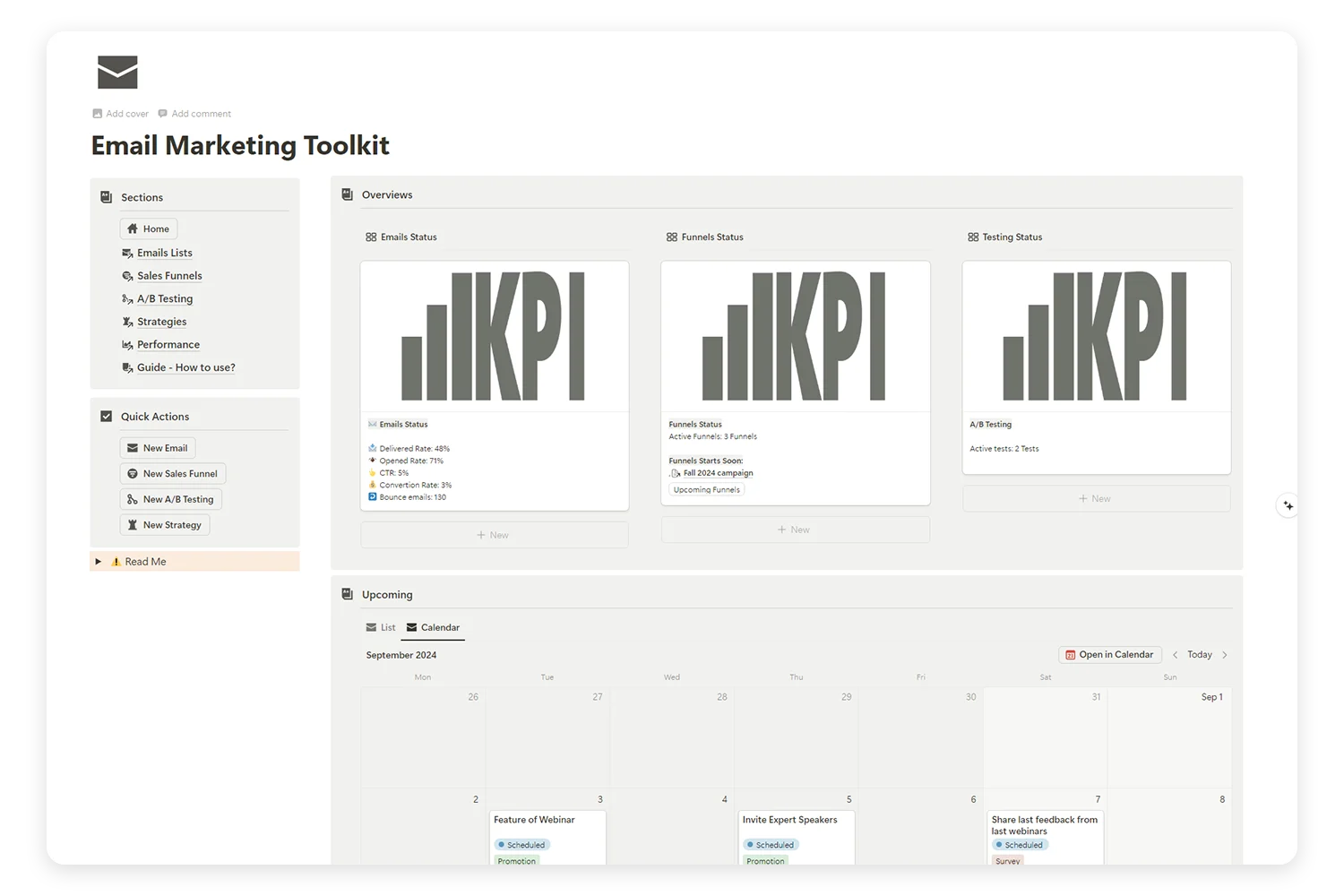
Supercharge Your Email Marketing with the Ultimate Toolkit!
Tired of juggling multiple platforms to manage your email campaigns, sales funnels, and A/B tests? Our Email Marketing Toolkit is here to organize, analyze, and optimize your email strategies—all in one place.
ROI benchmarks by program tier: low-ticket, mid-ticket, high-ticket, recurring
Every tier has its own ROI ceiling. Match the tier to your traffic source or the math breaks.
Low-ticket: $19 to $79 AOV
Examples: digital templates, ebooks, low-cost tools.
Math at $49 AOV, 30% commission:
- Commission per sale: $14.70
- Required conversion at $1 EPC: 6.8%
- Required conversion at $0.50 EPC: 3.4%
Tier reality: low-ticket programs need high conversion to break even. Best fit: warm email lists, retargeted social, pinned content. Cold traffic loses money.
Mid-ticket: $97 to $497 AOV
Examples: courses, premium templates, mid-tier SaaS annual plans.
Math at $297 AOV, 40% commission:
- Commission per sale: $118.80
- Required conversion at $1 EPC: 0.84%
- Required conversion at $0.50 EPC: 0.42%
Tier reality: mid-ticket is the sweet spot for most content marketers. Long-form articles, YouTube reviews, and newsletter sequences all work. Refund rate is the real risk: anything above 15% kills the math.
High-ticket: $500 to $5,000 AOV
Examples: enterprise SaaS, coaching, high-end software.
Math at $1,500 AOV, 25% commission:
- Commission per sale: $375
- Required conversion at $1 EPC: 0.27%
- Required conversion at $0.50 EPC: 0.13%
Tier reality: high-ticket pays huge per sale, takes 30 to 90 days to close. Long cookie windows are non-negotiable. Refund and chargeback risk is lower because buyers vet harder. Best fit: B2B newsletters, comparison content, case studies.
Recurring: SaaS subscriptions and memberships
Examples: tools with monthly or annual recurring commission.
Math at $49 per month subscription, 30% recurring, 18-month average customer life:
- Total commission per customer: $264.60
- Required conversion at $1 EPC: 0.38%
Tier reality: recurring compounds. A 0.5% conversion rate on a SaaS program with 18-month average life beats a 2% conversion rate on a one-time $200 product. Track customer life, not headline rate. Programs publishing under 6-month average customer life signal high churn and weak product.
Cross-tier comparison
Run the same audience through all four tiers. The winner depends on traffic warmth, content depth, and audience purchasing power. There is no universal best tier.
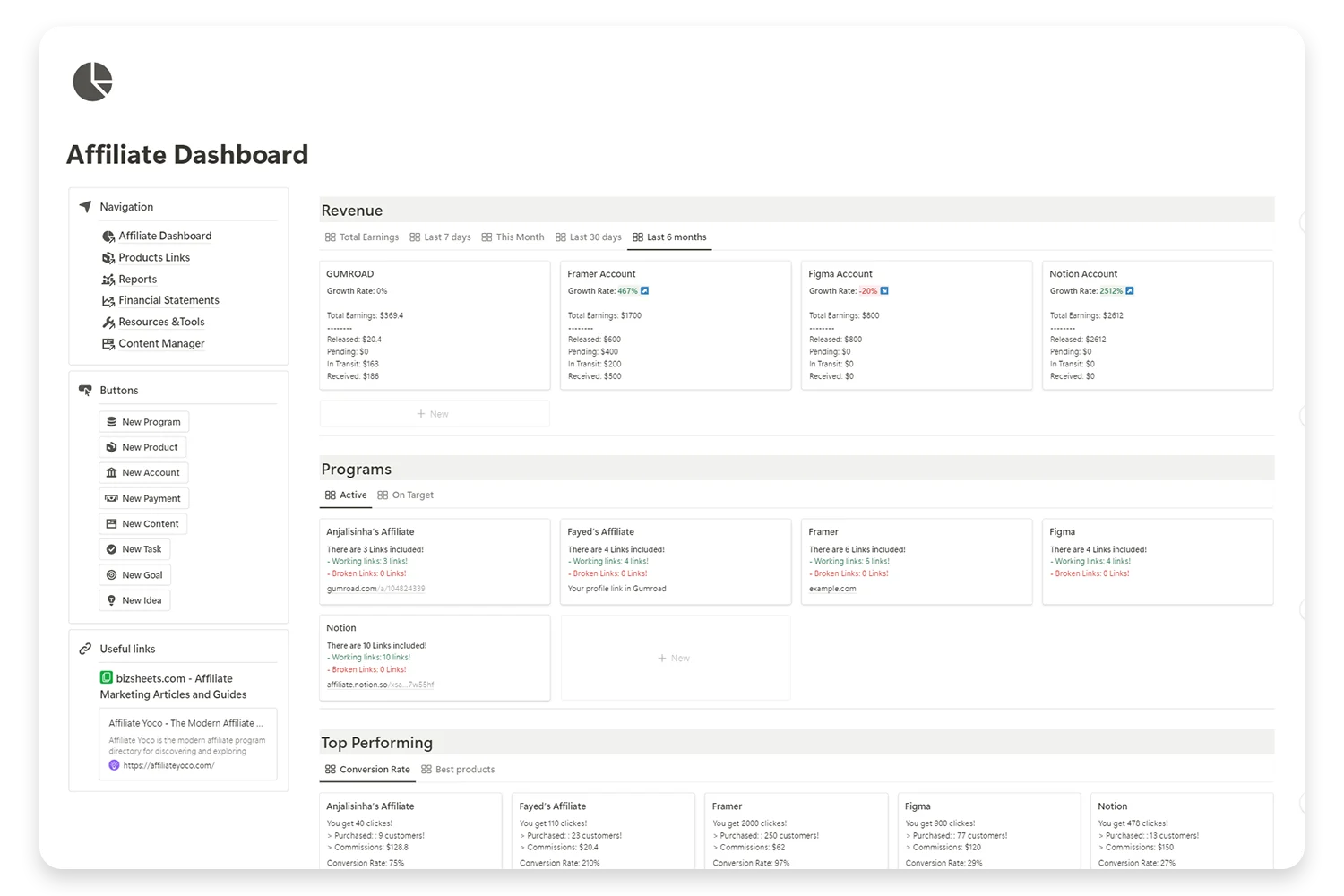
Elevate Your Affiliate Business with Expert Insight Management
Take control of your affiliate marketing with our comprehensive Notion template. Designed for efficiency and clarity, this template helps you manage your affiliate programs, track earnings, and optimize your strategies.
The 30-day ROI test: tracking, attribution, and the breakeven formula
Benchmarks predict. The test confirms. Every new program gets a 30-day window to prove the math.
Setup: tracking infrastructure
Three things must be in place before day one:
- A tracked link with UTM parameters (source, medium, campaign, content)
- A spreadsheet or database row per click source
- A baseline of your normal click rate from the channel
Without these, the test produces noise. The most common mistake is mixing test traffic with evergreen affiliate traffic. Use a separate UTM campaign tag for the test program.
Days 1 to 7: traffic and click test
Promote the program through one primary channel and one secondary channel. Track:
- Clicks per impression (channel-level CTR)
- Cost per click if paid traffic is involved
- Time invested in content creation
Output: cost per click, including time at $50 per hour content rate.
Days 8 to 30: conversion and refund window
Wait. Let attribution settle. Most programs need 14 to 21 days for conversions to register. Refunds appear in week 3 or 4.
Track:
- Tracked sales
- Reversed or pending sales
- Average commission per sale
Output: effective EPC and effective conversion rate.
Breakeven formula
Breakeven traffic = (content creation cost + paid traffic cost) / effective EPC
Example:
- 4 hours of content at $50 per hour = $200
- $0 paid traffic
- Effective EPC = $0.85
- Breakeven traffic = 235 clicks
If the channel produces 235 clicks in 30 days, the program breaks even. Less, the program loses. More, the program profits.
Decision matrix:
- 2x breakeven or more → scale, build a content series
- 1x to 2x breakeven → refine angle, retest in 30 days
- Under 1x breakeven → archive, revisit at 90 days
- Refund rate above 20% during the test → drop regardless of EPC
Where the template enters
Spreadsheets work for one or two programs. Past three, the math breaks down across tabs.
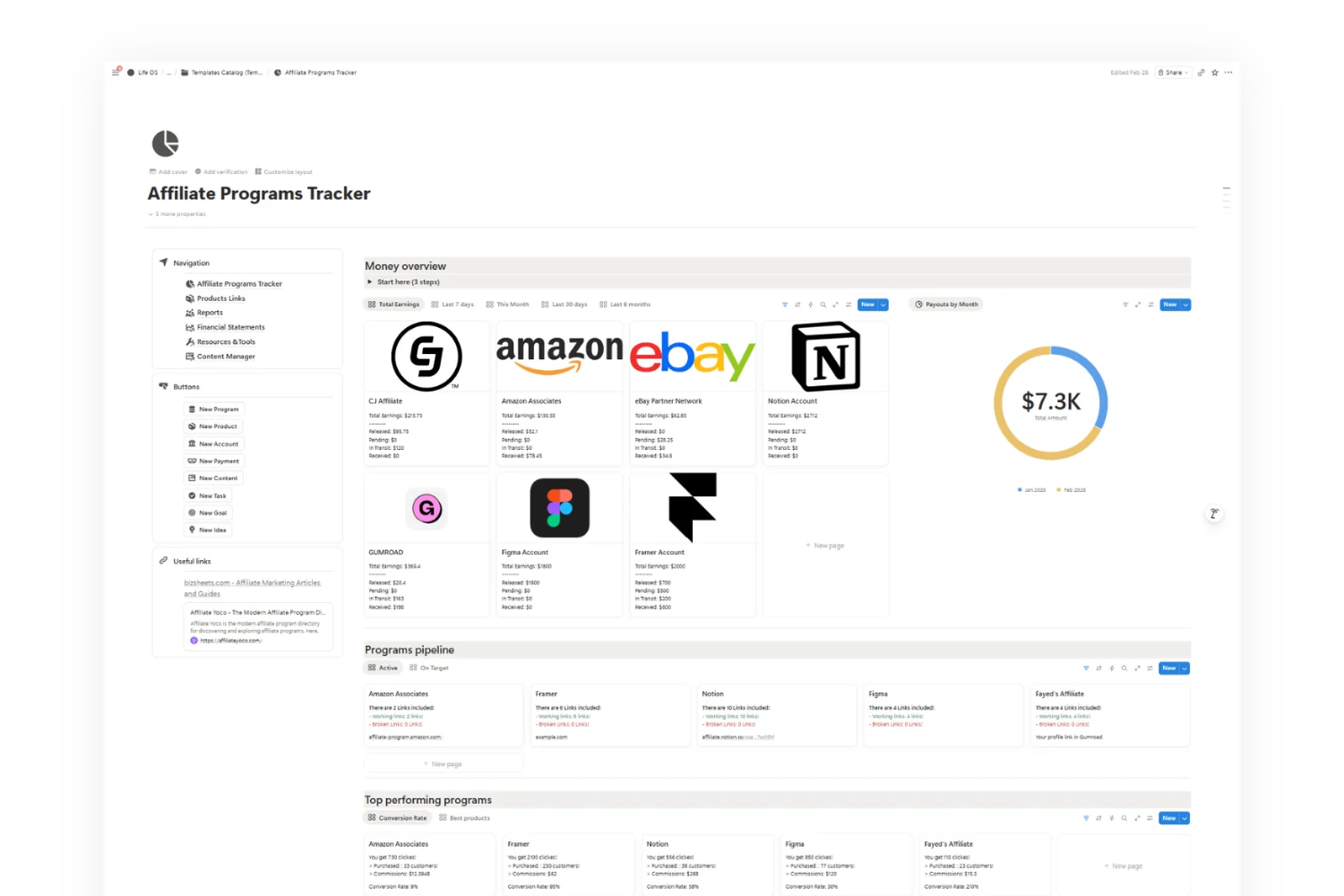
The Affiliate programs management template centralizes the 4-input ROI math in one workspace. The Affiliate programs database stores AOV, commission rate, average customer life, and refund rate as properties. The Products Affiliate Links database tracks live EPC, conversion rate, and clicks per channel. The Content database links every promotion to a program record, so 30-day ROI calculates automatically against breakeven.
Run the test once, log the result, then watch the program move up or down the ROI ranking against your portfolio.
Key Takeaway
Headline commission lies. Effective EPC tells the truth.
The 4 inputs (EPC, AOV, conversion rate, refund rate) reduce every high-paying affiliate program to one comparable number for affiliate program profitability. The 30-day test confirms the number against your audience. The breakeven formula tells you when to scale and when to drop.
Run the math on every program before signup. Run the test before scaling. Drop fast, scale slow.
FAQ
What is a good EPC for affiliate marketing?
Above $0.75 across the program is solid. Above $1.50 is top quartile. Below $0.30 drops your hourly rate below content creation cost for most niches.
How does refund rate change ROI?
Refund rate cuts effective EPC by the same percentage. A 20% refund rate on $1.00 EPC produces $0.80 effective EPC. Programs over 20% refund rate rarely make ROI sense outside warm email traffic.
Should I prioritize high-ticket or recurring affiliate programs?
Depends on traffic warmth. High-ticket pays per sale, takes longer to close, needs comparison content. Recurring compounds over 12 to 24 months, needs SaaS-fluent audiences. Run both tiers through one ROI test against your channel.
How long should a 30-day ROI test run before deciding?
Full 30 days. Conversions register at days 7 to 21. Refunds register at days 14 to 28. Cutting the test at 14 days inflates effective EPC by 30 to 50%.
What if my niche has no programs above $0.50 EPC?
Two options. Stack low-EPC programs through high-AOV bundles. Or audit the niche for adjacent products with stronger affiliate economics. Niches with structural EPC under $0.30 favor digital products and SaaS over physical goods.