

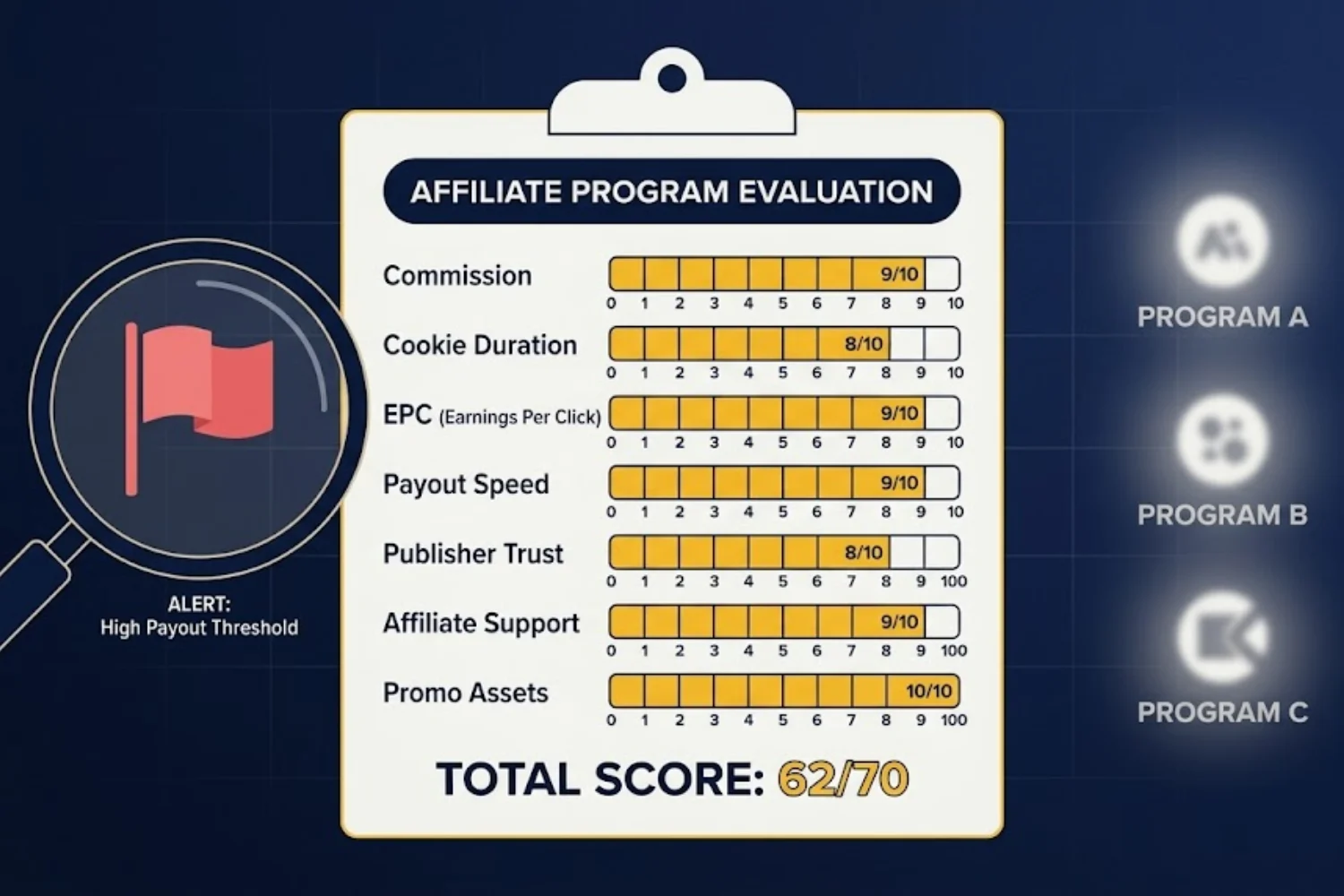
Affiliate income looks simple from the outside. Pick a program, drop a link, watch commissions roll in. The reality runs different. Most affiliate marketers sign up first and regret later. They chase headline payouts, miss broken cookies, and wake up to a 60-day attribution window with no recurring revenue.
The fix is not more programs. It is one repeatable filter you run before the click-through happens.
This article shows digital marketers how to evaluate affiliate programs with a 7-point vetting score. The score replaces gut calls with a single weekend test for vet profitable affiliate programs. Use it once, keep it forever. Every offer gets the same treatment, the same questions, the same number at the end.
By the time you finish reading, you will have:
- A 7-signal affiliate program checklist with weighted scores
- Niche-specific red flags for SaaS, info products, ecommerce, and finance
- A 48-hour test plan to validate one program from research to verdict
Table of Contents
What You’ll Learn
The 7 vetting signals of Vet Profitable Affiliate Programs
Every profitable program shares seven traits. The affiliate program checklist below scores each from 0 to 10. Total possible: 70. Pass threshold: 50.
1. Commission rate, normalized
Headline rate misleads. A 50% commission on a $19 product pays $9.50. A 20% commission on a $497 product pays $99.40. Convert every offer to dollars per sale before comparing.
Scoring guide:
- Above $30 per sale for digital products → 7 to 10
- $10 to $30 per sale → 4 to 6
- Under $10 per sale → 0 to 3
- Recurring commission for SaaS → add 2 bonus points
2. Cookie window
The cookie window decides how long your referral counts. Anything under 7 days hurts content marketers. Long-form articles get re-read, shared, and acted on weeks after publish.
Scoring guide:
- 90+ days or lifetime → 9 to 10
- 30 to 89 days → 6 to 8
- 7 to 29 days → 3 to 5
- Under 7 days → 0 to 2
- Last-click attribution by default → flag, not a deal-breaker
3. EPC, earnings per click
EPC is the program’s average earnings per 100 clicks across all affiliates. Networks publish it. Independent programs hide it. Ask before you sign.
Scoring guide:
- $1+ EPC → 9 to 10
- $0.50 to $0.99 → 6 to 8
- $0.20 to $0.49 → 3 to 5
- Under $0.20 or hidden → 0 to 2
If the program refuses to share EPC, score 0 and request a 30-day pilot before committing.
4. Payout proof
A program with no public payout history is a risk. Look for screenshots from real affiliates, payment dates inside the dashboard, and a clear minimum threshold. PartnerStack, Impact, and ShareASale publish dispute timelines. Custom programs hosted on Gumroad or LemonSqueezy use the platform’s own payout cycle.
Scoring guide:
- Verified payouts within 30 days, multiple proof points → 9 to 10
- Standard NET-30 with one or two proofs → 6 to 8
- NET-60 or longer → 3 to 5
- No proof, no schedule → 0 to 2
5. Brand trust
Your audience pays the price for a bad recommendation. Run three checks: search the brand name plus “scam,” scan their G2 or Trustpilot rating, and check refund policy. A 4.0+ public rating with a 14-day refund clears most concerns.
Scoring guide:
- 4.5+ rating, generous refund → 9 to 10
- 4.0 to 4.4, standard refund → 6 to 8
- 3.0 to 3.9 → 3 to 5
- Under 3.0 or recent fraud signals → 0 to 2
6. Affiliate support quality
The program’s responsiveness predicts your conversion rate. Email the affiliate manager with a real question about positioning. Track response time and depth.
Scoring guide:
- Response under 24 hours, named manager, custom assets offered → 9 to 10
- Response under 72 hours, generic help → 5 to 7
- Response over 5 days, copy-paste reply → 2 to 4
- No response after 7 days → 0
7. Asset library
Banners, swipe copy, and email templates save hours. A program with a well-stocked vault signals investment in affiliates.
Scoring guide:
- Full vault: banners, video, swipe, case studies → 9 to 10
- Basic banners and one swipe doc → 5 to 7
- Logo and a link → 1 to 4
- Nothing → 0
Building your scorecard: weights, thresholds, and red flags by niche
Now the math. The 7 signals carry equal weight by default. Niche shifts the weights.
Default weights
Each signal at 14.3% of the total. Pass threshold: 50 out of 70.
Niche-adjusted weights
SaaS and recurring offers
- Cookie window: increase weight by 25%
- Payout proof: increase weight by 20%
- Asset library: drop weight to 5%
- Commission rate: increase weight by 30%
- Asset library: increase weight by 15%
- EPC: drop weight to 10% because info products often show low advertised EPC with strong niche conversion
Ecommerce and physical products
- EPC: increase weight by 25%
- Cookie window: increase weight by 20%
- Affiliate support: drop weight to 5%
Finance and high-ticket B2B
- Brand trust: increase weight by 35%
- Payout proof: increase weight by 25%
- Asset library: drop weight to 3%
Pass thresholds
- 50 to 70 → join, build a 30-day promotion plan
- 35 to 49 → join, test for 30 days, promote selectively
- Under 35 → skip or revisit in 6 months
Red flags by niche
Some signals override the score. Hit any of these and the program drops, regardless of total points.
- SaaS: trial-only commission with no recurring → skip
- Info products: refund window under 7 days → skip
- Ecommerce: cookie under 24 hours plus no email retargeting → skip
- Finance: no compliance documentation → skip
- Any niche: payout threshold over $100 with monthly minimums → flag and negotiate
Running the test: one program, one weekend, one verdict
The score works on paper. The test confirms it works in your business. One weekend, one program, one verdict.
Friday: Research and signal scoring
Block 90 minutes. Open a fresh document and run the 7 signals in order. Pull data from the program’s affiliate page, the network dashboard, and one public review source. Time per signal: 10 to 15 minutes.
Output: a number out of 70 and a written note for each signal.
Saturday: Asset and audience review
Block 60 minutes. Pull the program’s swipe copy and rewrite one email and one social hook in your voice. Send the email to a test list of 10 to 25 subscribers. Post the hook to a low-stakes channel.
Output: open rate, click rate, and one piece of audience feedback.
Sunday: Verdict
Block 30 minutes. Combine three numbers:
- Vetting score out of 70
- Test email click rate vs. your channel average
- Audience signal: positive, neutral, or pushback
Decision matrix:
- Score 50+ and click rate at or above your average → green light, build a 30-day promotion plan
- Score 50+ and click rate below average → yellow, refine angle and re-test in 14 days
- Score 35 to 49 → red, archive the program with a 6-month review date
- Audience pushback regardless of score → red, do not promote
Where the template enters
At this point, paper notes break down. Programs accumulate. Links multiply. Earnings get hard to compare.
The Affiliate programs management template runs the lifecycle in one workspace. The Affiliate programs database carries the 7-signal score as a property. The Products Affiliate Links database tracks EPC, conversion rate, and earnings per click against your benchmarks. The Content database links every promotion back to a program, so you see which scores translate to revenue.
Run the score, log it on the program record, then watch how the live numbers compare to the prediction over 30 days.
Key Takeaway
The 7-point affiliate program checklist replaces gut calls with one repeatable test for vetting affiliate networks. Run it on every program before the first signup. Score, test, decide, log. The same process catches red flags, surfaces hidden winners, and protects audience trust.
One weekend. One verdict. Every program.
FAQ
How long does the 7-point score take per program?
First run: 90 minutes. After three programs, drops to 30 minutes. The format becomes muscle memory.
What if a program scores 50 but my audience hates the brand?
Audience signal beats score. The vetting framework filters bad programs. Audience feedback filters wrong-fit programs. Both must pass.
Should I rescore programs already in my portfolio?
Yes, every six months. Cookie windows shrink, payout terms shift, brand reputation moves. A program at 60 today might score 40 next year.
What is the difference between EPC and earnings per click?
None. EPC is the network’s average. Earnings per click on your dashboard is your specific number against that program. Aim to beat the network EPC inside 90 days.
Is the score useful for high-ticket affiliate programs?
Yes, with weights shifted toward brand trust and payout proof. The framework adapts to niche, payout size, and sales cycle length.