The Amazon Review Tracker Notion Template Built for FBA Brands
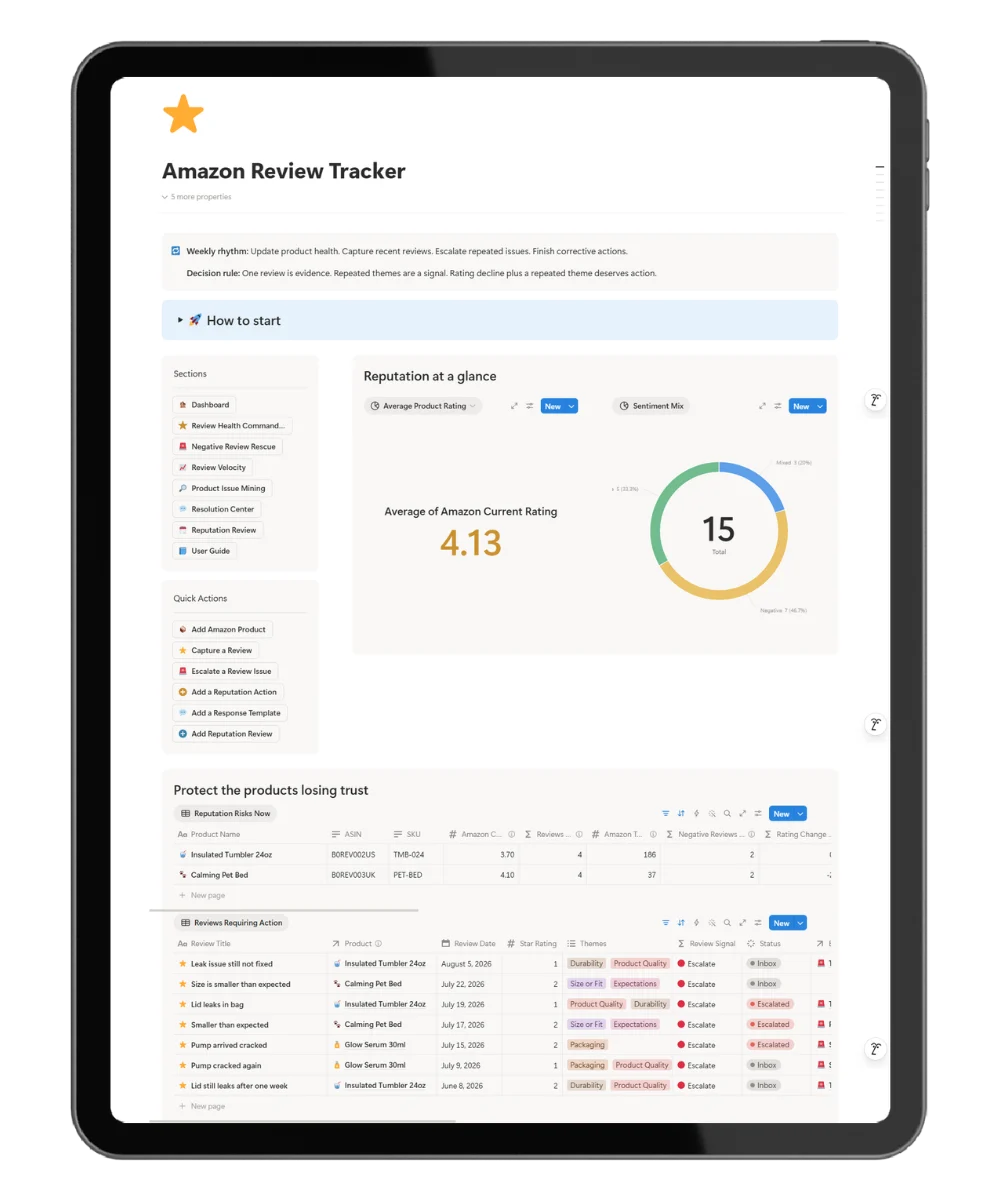
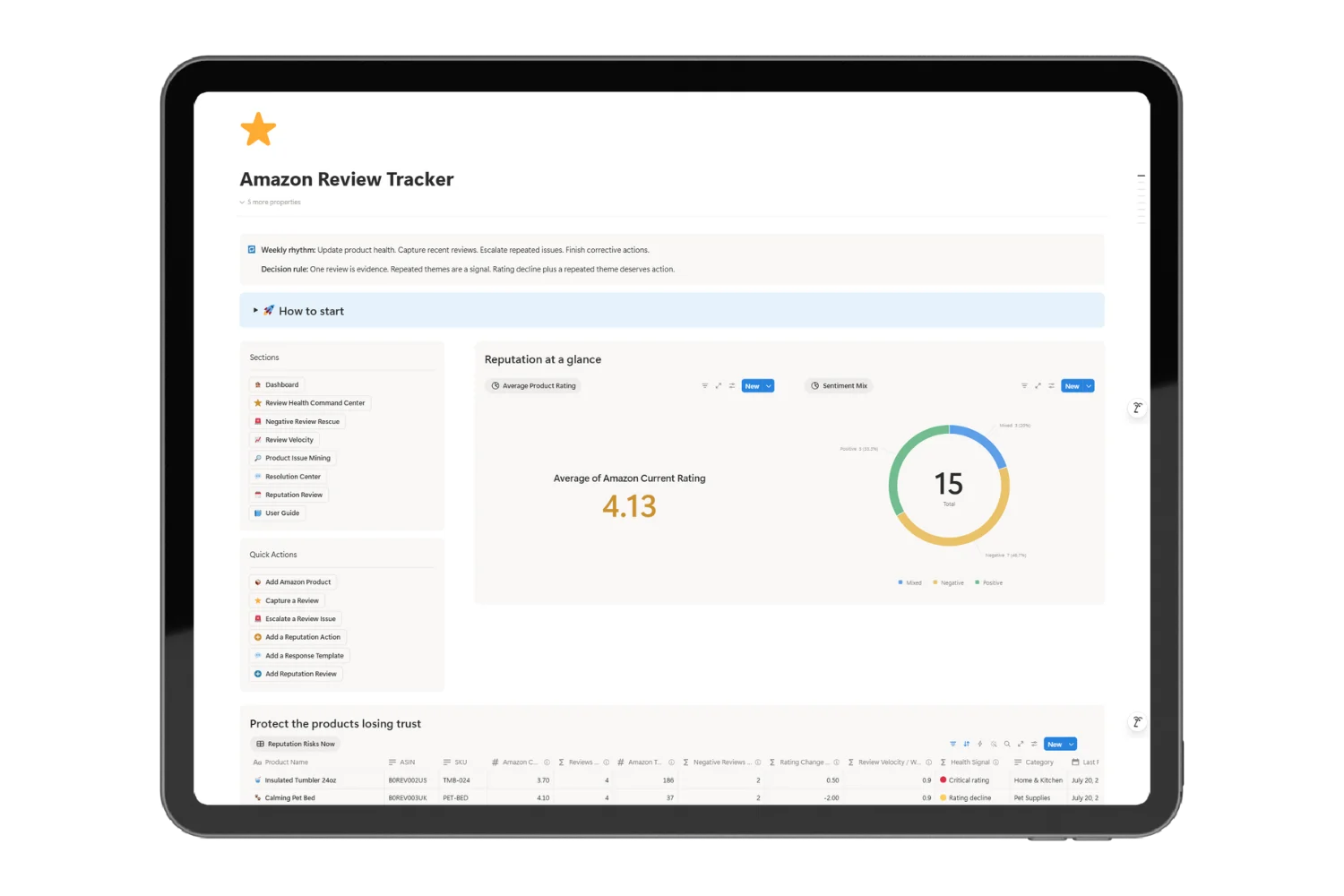
The amazon review tracker notion template is the rating protection system for sellers who refuse to lose stars to problems they already had the data to see. Every ASIN carries a health signal. Every review carries a sentiment and a theme.
Every repeat negative pattern turns into an escalation with a root cause and an owner. Every month closes with a written reputation score and a next-priorities list. This is what a real amazon review tracker notion template looks like when the goal is to defend a listing, not just watch it.
The Problem Sellers Keep Repeating
Reading reviews is not a system. Most sellers open Seller Central on Monday, scroll through the new 2-star reviews, reply from memory, and forget the pattern by Wednesday. Three weeks later the star rating moves from 4.6 to 4.4 and the Q4 launch is in trouble. The cost is not the review. The cost is the second, third, and fourth time the same complaint appeared and nobody logged it.
- Reviews scatter across three tools nobody updates past week two.
- Repeat themes get answered as one-off replies instead of escalations.
- Response language is inconsistent because it lives in someone’s head.
- Rating decay only becomes visible after Amazon shows the drop.
- The monthly reputation view does not exist, so leadership sees the revenue drop before the reputation drop.
The Promise This Amazon Review Tracker Notion Template Delivers
By using the amazon review tracker notion template you will:
- See rating decay 30 days before Amazon updates the visible star rating.
- Know exactly which ASIN to fix first every Monday morning.
- Turn repeat negative themes into escalations that actually close.
- Ship approved response language across every reviewer on your team.
- Finish each month with a written reputation score, wins, risks, and next priorities.
Why Connected Beats Stacked
Most sellers stack tools. A scraper for reviews. A spreadsheet for actions. A Slack channel for escalations. A note file for response language. The amazon review tracker notion template replaces the stack with a connected reputation system where every review points at the escalation it belongs to, every escalation points at the corrective action it triggers, and every action points at the response template that was used. The result is a rating protection loop instead of a review reading habit.
The Signal Layer That Holds It Together
The untold story behind rating protection is not the review itself. It is the signal layer. Every ASIN in the amazon review tracker notion template carries a live health signal driven by review velocity, sentiment split, and rating trend. That signal is what tells a seller which product to review first every Monday, without opening a spreadsheet, without reading every new review, and without waiting for Amazon to update the star. Rating decay becomes visible in the workspace weeks before it becomes visible in the marketplace.
Outcomes You Get
- Rating protection on every ASIN. No more surprise star drops after a review cluster.
- A defensible monthly reputation review. One score, one page, one export.
- Fewer wasted replies. Escalations replace one-off responses when the theme repeats.
- A shared source of truth. Every teammate reads the same reputation signal.
- Faster response cycles. Approved language ships from one library.
Features Overview
- Products & ASINs profile. Health signal, tracked reviews, tracked average rating, rating change 30d.
- Product Reviews log. Star rating, verified purchase, signal, sentiment, and theme.
- Review Escalations flow. Root cause, owner, due date, resolution notes.
- Reputation Actions. Priority, urgency signal, template used, template used date.
- Response Templates library. Approved language organized by star rating and theme.
- Monthly Reputation Reviews. Reputation score, wins, risks, next priorities.
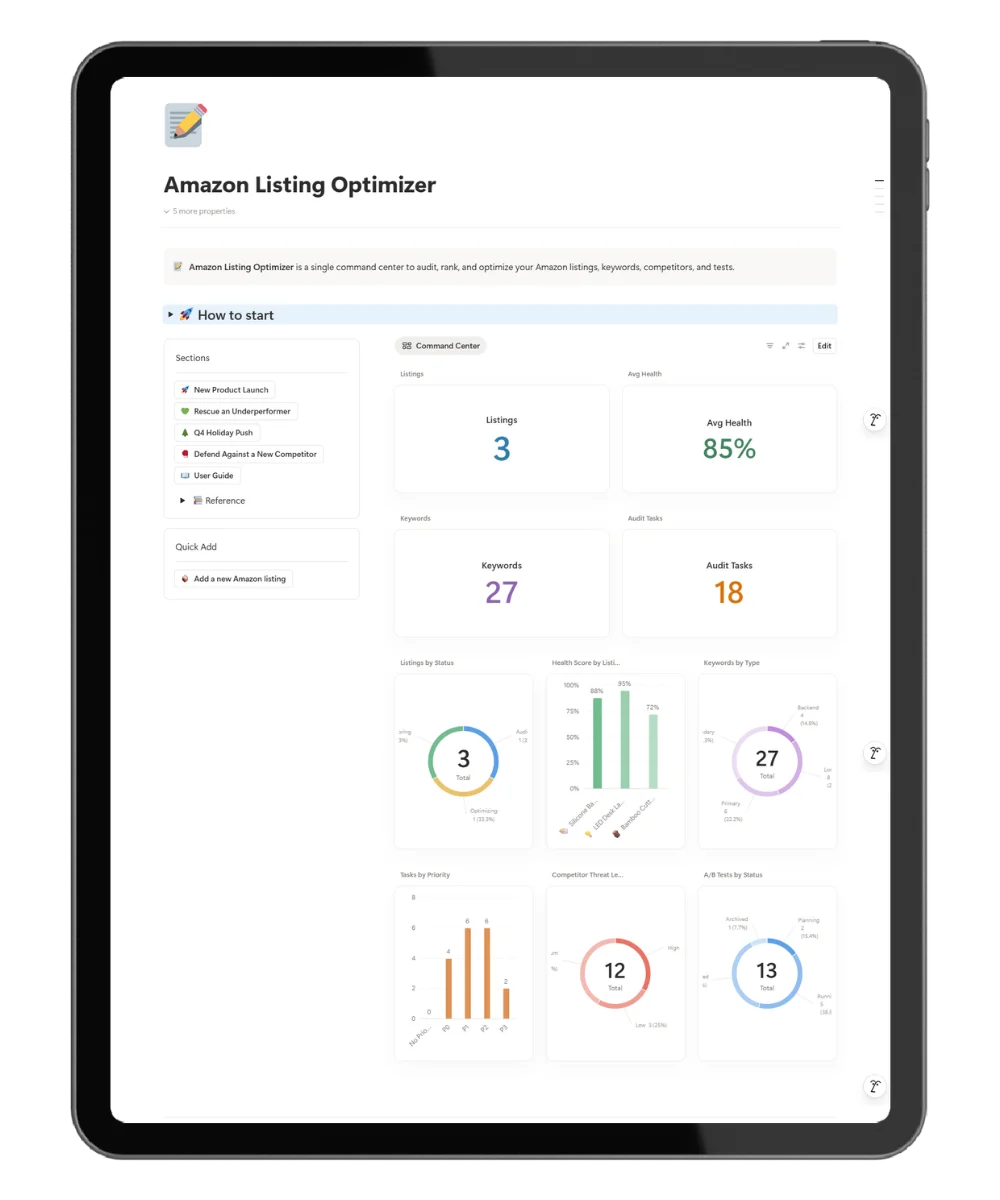
- Scenario pages. Review Health Command Center, Negative Review Rescue, Review Velocity and Launch Watch, Sentiment and Product Issue Mining, Response and Resolution Center, Monthly Reputation Review.
- Intake forms. Fast capture without touching layouts.
- Operating guide. Weekly rhythm, sentiment tagging, escalation criteria, response rules, monthly review workflow.
Who It Is For
- Amazon FBA sellers running 1 to 20 ASINs who refuse to lose Q4 to a review cluster.
- Private-label brand owners defending a launch and a rating at the same time.
- Small e-commerce teams that want an amazon seller reputation tracker beside their brand operation.
- Solopreneurs who need a real amazon review management notion template, not another spreadsheet.
FAQ
What is the amazon review tracker notion template exactly?
It is a Notion workspace built for Amazon sellers to log reviews by ASIN, tag sentiment and themes, run escalations on repeat problems, ship approved responses, and close each month with a written reputation score.
Do I need any external tool to use it?
No. The amazon review tracker notion template runs entirely inside Notion. Any scraper you already use for bulk review pulls plugs in through the intake form.
How many ASINs does it support?
One to a few hundred. The system was designed for solo sellers and small brand teams running 1 to 20 ASINs, and it scales without breaking for larger catalogs.
How long does setup take?
About 20 minutes to add ASINs and confirm the response library. First weekly reputation check runs the same day.
Does the template work for multiple marketplaces?
Yes. Each ASIN carries a marketplace tag. The monthly reputation review can be filtered per marketplace so US, UK, DE, and other stores each get their own snapshot.
Can I use it with a small team?
Yes. Escalations and reputation actions both carry an owner field. Response Templates keep language consistent across VAs and customer service teammates.
Do I get future updates?
Yes. Lifetime updates are included. When a new release ships, re-duplicate the latest version into your workspace.
Does this replace Helium10 or Jungle Scout?
No. The amazon review tracker notion template is the reputation layer beside those tools. Keep your data source and use this workspace to turn the data into escalations, actions, and a monthly reputation score.