
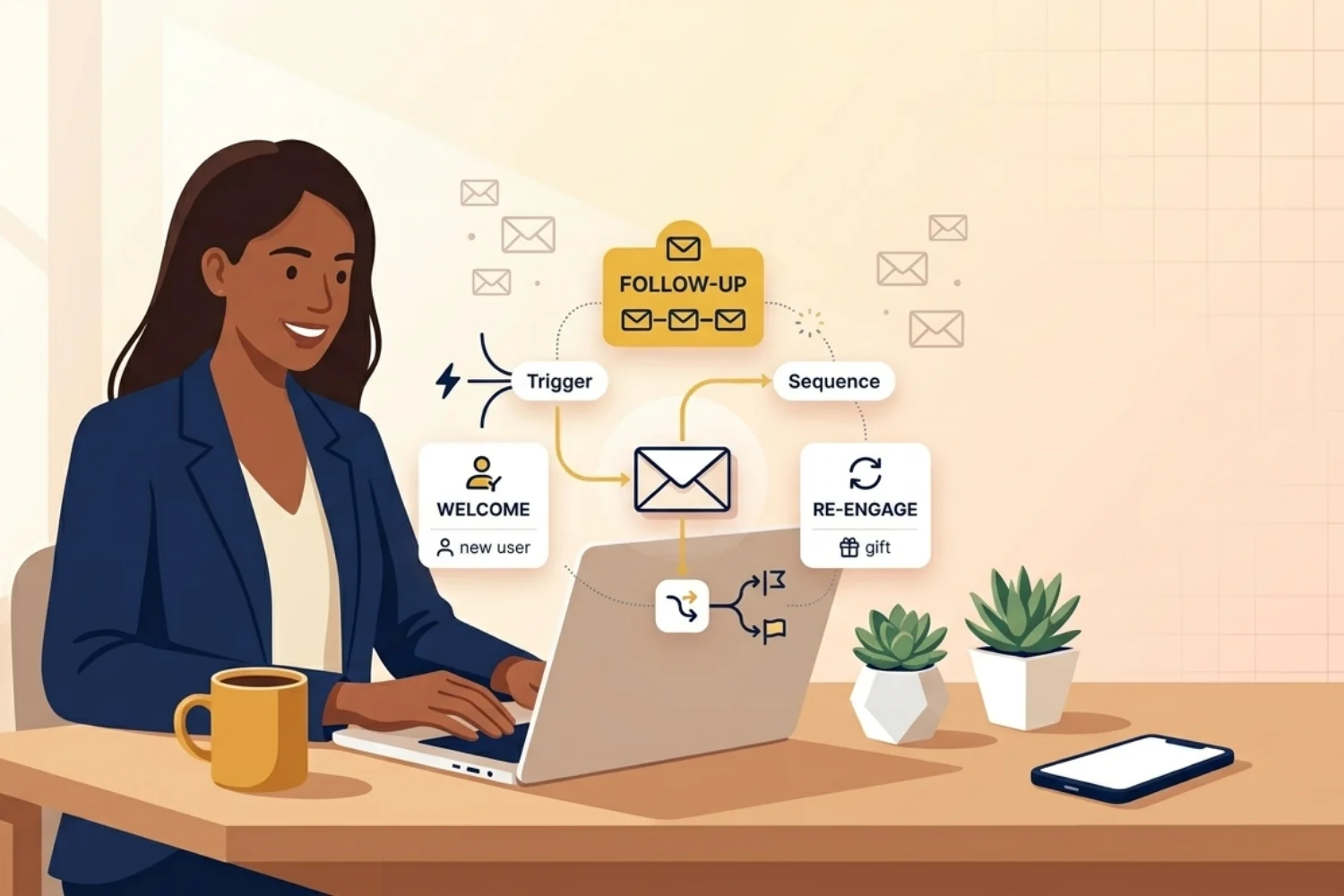
Email marketing for solopreneurs is the cheapest revenue lever you own. No ad budget. No team. One email tool plus a list of people who already trust you.
This guide walks through the sequences bringing in repeat work, the templates you swipe straight into your tool, and the lean stack running on autopilot while you sleep.
TL;DR
- Email keeps past clients close and brings them back without cold outreach.
- Five sequences do 80% of the work: welcome, lead-magnet nurture, onboarding, post-project, and re-engagement.
- The right tool fits your stage. Free tier first, paid tier when you outgrow it.
Table of Contents
What You’ll Learn about Email Marketing for Solopreneurs
What Is Email Marketing for Solopreneurs?
Email marketing for solopreneurs is the practice of sending automated and broadcast emails to subscribers, past clients, and prospects to build relationships, sell services, and stay top of mind.
It’s the only marketing channel you fully own. Your social account is rented. Your SEO traffic is borrowed. Your list is yours.
A solopreneur runs email differently from a brand with a team:
- One voice, one inbox, one calendar.
- Smaller list, higher trust per subscriber.
- Less automation overhead, more reliance on templates.
- Focus on services and recurring clients over cold transactions.
The output is the same outcome bigger brands target. More revenue per subscriber. The setup is leaner.
6 Benefits of Email Marketing for Solopreneurs
1. Recover Revenue from Past Clients
Your warmest leads are the people who already paid you. A short check-in email three months after a project ends often books a follow-up gig. The math is simple: cheaper to re-sell than to find someone new.
2. Sell Services Without Sales Calls
A nurture sequence does the talking for you. Each email educates, raises trust, and surfaces your offer. By the time a subscriber books, they pre-qualified themselves.
3. Cut Ad Spend
Every dollar on ads is rented attention. A 500-person list reached weekly costs near zero and delivers warmer traffic than any cold campaign.
4. Build Authority in Your Niche
A weekly email forces you to think in public. Over six months, the archive becomes a portfolio of your thinking. Clients land at your booking page already convinced you know your work.
5. Stay Top of Mind Between Launches
You launch a product or open a service window every few months. Email keeps the audience warm in the gap. When the doors open, the list buys first.
6. Free the Calendar with Automation
Automation does the grunt work. Welcome flow handles new subscribers. Booking-open sequence runs your sales cycle. You write once and the system delivers forever.
7 Email Campaigns Every Solopreneur Needs
1. Welcome Sequence
The welcome sequence is the most important set of emails on your list. New subscribers are at peak attention. Use it.
A three-email welcome flow looks like:
- Email 1 (immediate): deliver the freebie, set the relationship tone.
- Email 2 (day 2): share your story and what you stand for.
- Email 3 (day 5): point them to one paid service with a soft CTA.
Open rates on welcome emails average 60-80%, the highest of any sequence. Bake the most important link of your business into this flow.
2. Lead-Magnet Delivery + Nurture
A lead magnet brings them in. A nurture sequence keeps them.
After the welcome flow ends, drop new subscribers into a 4-6 email nurture covering one topic deeply over two weeks. Each email points to a related case study or service page at the bottom.
3. Client Onboarding Email
When a new client books, an automated onboarding email saves you 30 minutes per project.
Include:
- Welcome message and timeline expectations
- Calendar booking link for kickoff
- Forms or briefs they need to fill out
- Payment confirmation and invoice link
- Your office hours and response time
One email, sent automatically when a project starts, replaces five back-and-forth messages.
4. Post-Project Follow-Up
Two weeks after delivery, an automated email asks:
- How the project landed
- Permission to use the work as a case study
- A request for a testimonial or review
- A soft mention of your next available booking slot
This single email is the highest-ROI message in your list. It generates repeat work, referrals, and social proof at zero ongoing cost.
5. Service Waitlist or Booking-Open Email
When you open new client slots, the list gets first access. Send a heads-up 48 hours before the public announcement, then a “doors open” email when slots go live.
A 200-person list often fills two to three slots before the offer ever hits social media.
6. Monthly Work-in-Public Newsletter
Once a month, share:
- What you shipped
- One lesson from a recent project
- A useful link or tool from your stack
- What you’re working on next
Short. Honest. Personal. This newsletter builds the relationship the rest of the year. Three paragraphs beat a polished design every time.
7. Re-Engagement Sequence
Subscribers go quiet. Sometimes for life reasons, sometimes because your emails stopped landing.
A two-email re-engagement runs:
- Email 1: “Still want to hear from me?” with a clear stay-subscribed CTA.
- Email 2 (5 days later): “I’ll remove you in 48 hours unless you click here.”
Whoever clicks stays. Whoever doesn’t gets cleared. Smaller list, higher engagement, better deliverability.
3 Email Templates Solopreneurs Steal Today
Template 1: Welcome Email
Subject: Your [freebie] is here. One thing before you go.
Body:
Hey [first name],
Here’s the [freebie] I promised: [link]
Quick intro since you’re new here. I’m [name], a [role] who helps [audience] [outcome]. I send one email a week with practical [topic] insights you won’t find on my blog.
If it sounds useful, you’re in the right place. If not, the unsubscribe link is right below.
Talk soon,
[Your name]
P.S. Reply with the one [topic] question you’re stuck on right now. I read everything.
Template 2: Post-Project Follow-Up
Subject: Two weeks in. How’s it going?
Body:
Hey [first name],
It’s been two weeks since we wrapped [project name]. Wanted to check in.
- Is the [deliverable] doing what you hoped?
- Anything you’d tweak now you’ve lived with it?
- Open to a quick testimonial if you have a few minutes?
I’m taking [number] new clients in [month]. If you know anyone needing [outcome], my booking page is here: [link]
Thanks for the trust,
[Your name]
Template 3: Booking-Open Email
Subject: Two slots opened for [month]
Body:
Hey [first name],
Two new client slots opened for [month]. List gets first pick before I post anywhere else.
Quick recap of what I do:
- [Service one] in [timeframe]
- [Service two] in [timeframe]
- [Outcome a past client got]
Book here: [link]
First come, first served. Public announcement goes out Friday.
[Your name]
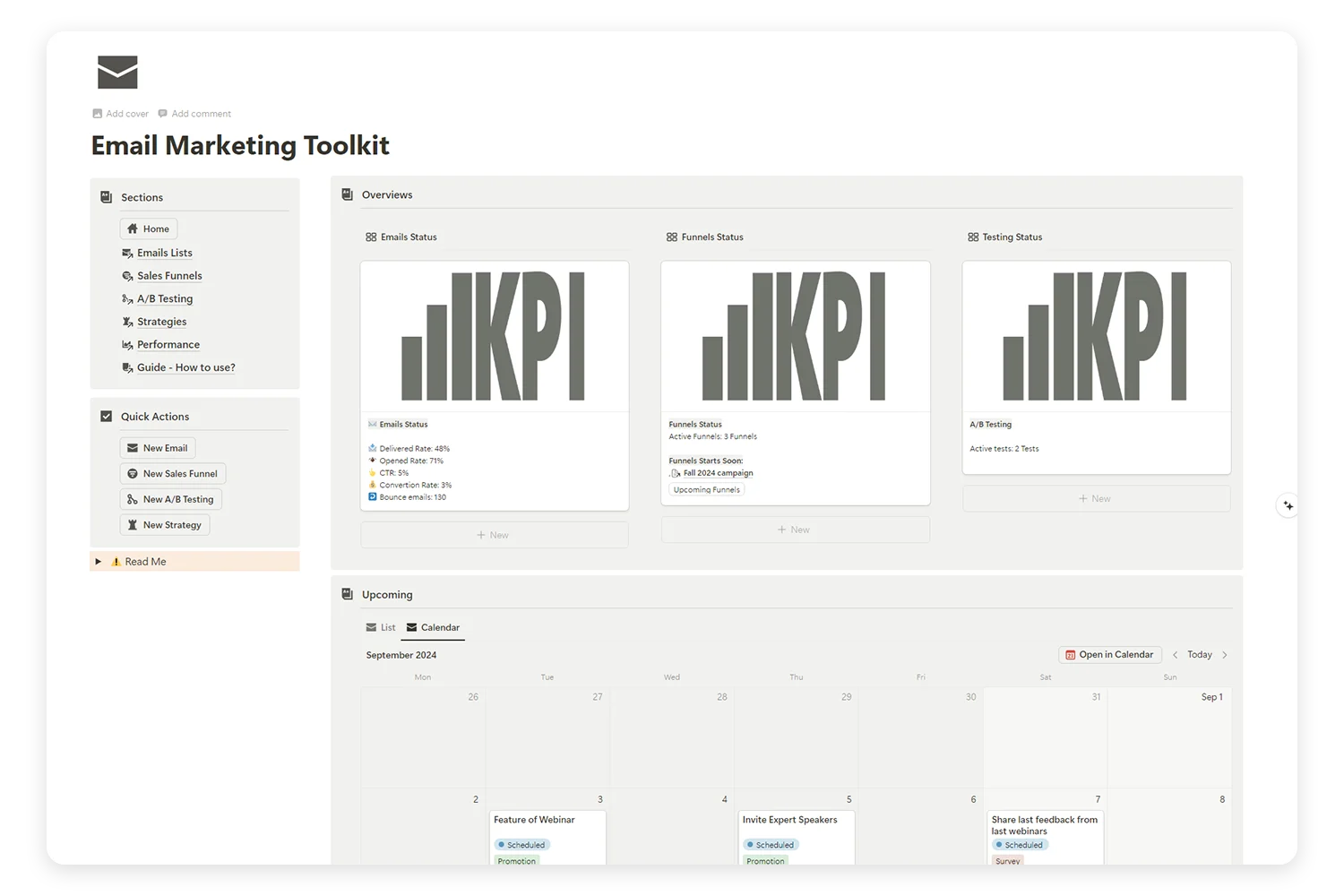
Supercharge Your Email Marketing with the Ultimate Toolkit!
Tired of juggling multiple platforms to manage your email campaigns, sales funnels, and A/B tests? Our Email Marketing Toolkit is here to organize, analyze, and optimize your email strategies—all in one place.
Best Practices for Email Marketing for Solopreneurs
Batch Your Writing
Pick one writing day a month. Draft the next four newsletters in one sitting. Schedule them. Your future self thanks you every Friday.
Keep the Stack Light
One email tool. A landing page builder if you sell digital products. Nothing else. Heavy stacks slow solo operators down. Pick a tool with automation, broadcasts, and signup forms in one place.
Use a Single CTA per Email
Every email points to one action. Book a call. Read this post. Reply to this thread. Multiple CTAs split attention and lower click-through.
Respect Consent Rules
GDPR, CAN-SPAM, and CASL all apply if you sell across borders. Get explicit opt-in. Include a clear unsubscribe link. Document where each subscriber joined the list.
Write Like You Talk
Your readers signed up for your voice. Stiff corporate writing breaks the bond. Read each draft out loud. If you wouldn’t say it on a call, rewrite it.
Track One Metric
Pick one number and watch it monthly. Most solo operators pick reply rate or click-through. Vanity metrics like open rate matter less since Apple Mail Privacy Protection.
Picking the Right Email Tool
Your stage decides your tool:
- Under 500 subscribers, no automation: any free plan from Mailchimp, MailerLite, or Brevo handles you.
- 500-2,000 subscribers, basic automation: MailerLite paid, ConvertKit Creator, or Brevo Starter.
- 2,000+ subscribers, advanced automation, tagging, segmentation: ConvertKit, ActiveCampaign, or Customer.io.
The full breakdown sits inside the Free vs. Paid Email Automation Tools guide.
Switch tools only when the friction costs you more than the migration time. Otherwise stay put and ship more emails.
FAQ
How often should a solopreneur send emails?
Once a week beats daily. Consistency over volume. Pick a day, send every week, never apologize for showing up.
Does email marketing work for service businesses?
Yes. Services rely on trust more than products do. Email is the trust-building channel. Most consultants and freelancers earn 30-60% of new revenue from their list.
How big should my list be before email matters?
Day one. A 50-person list with five buyers beats a 5,000-person list of strangers. Start before you feel ready.
Should I write emails myself or use AI?
Write them yourself for at least the first 50 broadcasts. Your voice is the asset. Once your voice is on the page, AI helps with first drafts and subject-line variants. Never with the entire email.
What’s the minimum viable email setup?
One tool, one welcome flow, one weekly newsletter. Add a post-project follow-up automation email when you have repeat clients. Add a re-engagement flow at month six.
Next Steps
Pick one campaign from the list. Set up the welcome flow first if you’re new. Set up the post-project follow-up first if you have past clients sitting in your inbox.
Ship one sequence this week. Iterate next week. By month three, your list runs on autopilot and your inbox brings work to you instead of the other way around.
If you came here from the pillar guide Email Marketing Automation for Beginners: Sequences, Triggers, and Workflows Explained, the welcome sequence playbook is your next stop.