

The Screenshot vs the Monday Morning
After 3 years building Notion templates for solopreneurs and small teams, I’ve watched the same sales-template mistake repeat hundreds of times. People pick a template because the screenshots look clean. Three weeks later, the pipeline is empty, the follow-ups are missed, and the template sits archived.
A great sales template is not the one with the prettiest cover. It’s the one you open every Monday morning, fill in 90 seconds, and trust to tell you who to call today.
So what makes the best sales template? Five jobs done well, three failure modes avoided, and one test passed every single week.
What Best Sales Template Means in Practice
A sales template is not a full CRM. A CRM aims to hold every interaction with every contact across the org. A Notion CRM template built for sales aims at one thing: turn leads into closed deals on a repeatable schedule.
The best sales template does five jobs:
- Pipeline view: one place to see every open deal by stage, owner, and value.
- Contact database: every lead and customer with one row, one history, one set of next actions.
- Follow-up tracker: automatic reminders, never relying on memory.
- Reporting: closed-won, conversion rate, average cycle time, sources.
- Simplicity: a 90-second daily check, not a 30-minute admin session.
A template earns the word “best” when those five jobs feel like one workflow, not five separate dashboards stitched together.
The 3 Failure Modes of Most Sales Templates
Most sales templates fail one of three ways. Recognize the pattern early and you save weeks of pain.
Failure mode 1: Over-engineered
Forty-seven properties on a contact card. Custom rollups three levels deep. Charts on charts on charts. The sales tracker Notion experience starts beautiful and ends in paralysis. You spend more time maintaining the template than working leads.
Failure mode 2: Under-functional
A pretty kanban board with no follow-up reminders. A contact list with no deal stages. A sales pipeline template showing what is happening today but telling you nothing about what to do tomorrow. Looks good. Does nothing.
Failure mode 3: Hidden cost
Free starter, locked features. Or a one-time price followed by an upgrade path four times the original price. Or a paid template needing another paid add-on to log calls. The best CRM for solopreneurs has visible pricing from day one.
The trade-off behind every working sales template is the same: simplicity versus completeness. Push too far one way and the template becomes useless. Push too far the other way and it becomes a second job.
The 5 Criteria Every Sales Template Must Pass
Print this list. Pin it next to your monitor. The next time you evaluate a sales template, score it against five criteria. Three or more passes and the template is worth a trial.
1. The Monday Test
Open the template Monday at 9 AM. Within 60 seconds, you see: open deals by stage, this week’s follow-ups, deals at risk. No clicks. No filters. No view-switching.
2. The 90-Second Test
Add a new lead. Set the next action. Schedule a follow-up. The whole flow takes 90 seconds or less. If it takes longer, your sales reps will skip it on busy days.
3. The Follow-up Test
Set a follow-up date. Close the template. Reopen tomorrow. The follow-up appears on the dashboard automatically. No second tool. No reminder app. No relying on memory.
4. The Reporting Test
At month-end, the template tells you: deals closed, conversion rate, average cycle time, and source breakdown. Without exporting to Excel.
5. The Stage-Fit Test
A solo freelancer needs a different sales template than a 5-person team. The best sales template fits your stage today and gives you a clear upgrade path when you outgrow it.
⏱️The math most buyers miss before picking a sales template:
A pre-built template takes 2 minutes to duplicate and 30 to 60 minutes to fill with current clients. A build-from-scratch effort takes a full weekend before it stabilizes.
Value your time at $50 an hour and building from scratch costs $400 of weekend time before the first sale closes. A $29 template, set up in an hour, costs $79 all-in and ships on Monday.
Best Sales Template Picks by Stage
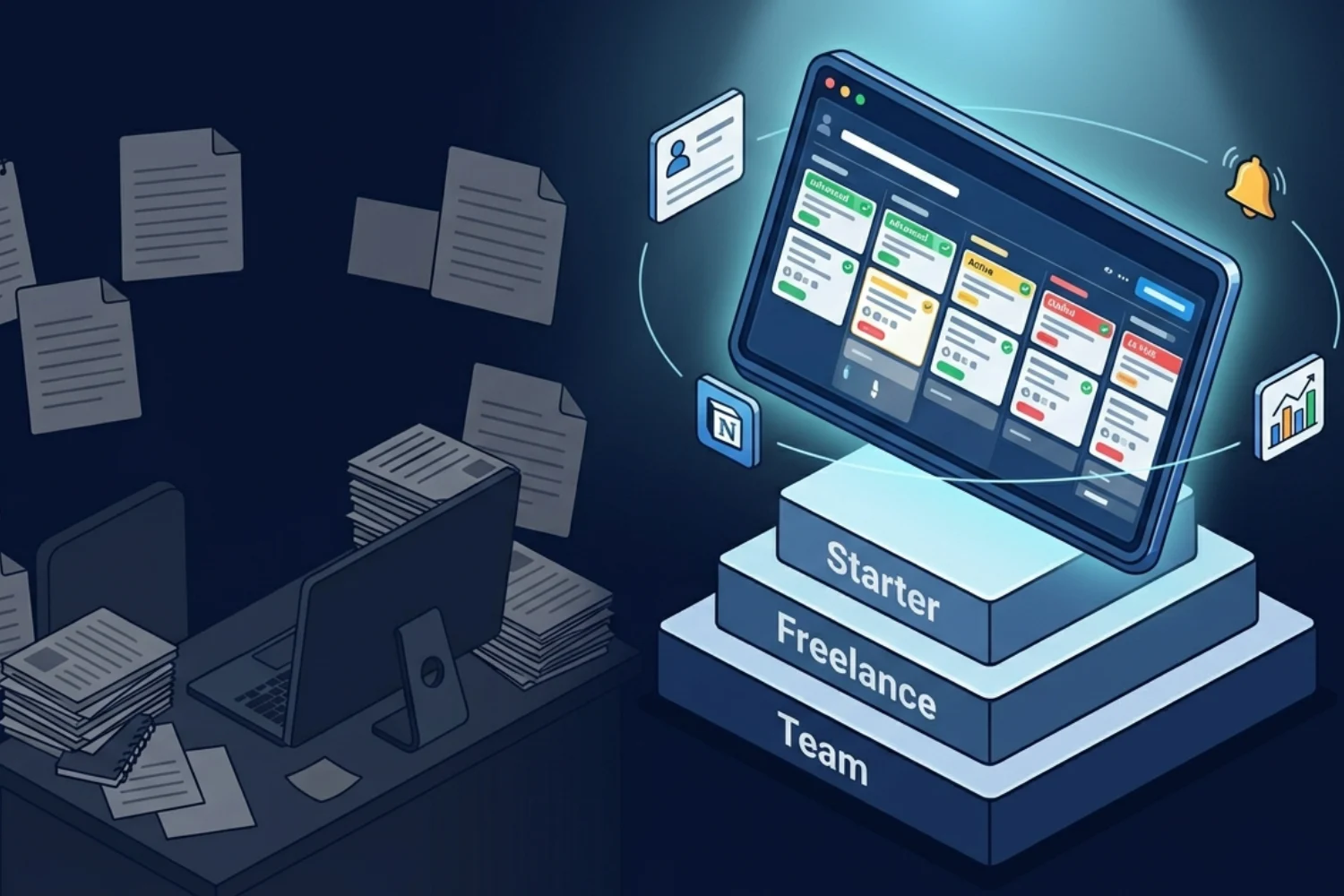
No single Notion CRM template wins for everyone. Pick by stage, not by aesthetics. Three tiers cover most growing teams.
Solo starter, free
CRM V.2 Basic (free). Best for the operator with 5 to 30 active leads, running the business alone, needing a clean pipeline without paid commitments. Five jobs done well, no upgrade pressure. The fastest way to start free and upgrade later when revenue justifies the next step.
Solo paid, for freelancers and one-person operators
CRM Freelance. best CRM for solopreneurs and freelancer or consultant carrying 30 to 100 active leads, juggling 5 to 15 active clients, and tracking proposals, contracts, and recurring revenue in one place. Pre-built client onboarding flow. Built-in invoice trigger. Reporting that answers “where did this month’s revenue come from?” without a spreadsheet.
Small team, paid
CRM Team. Best for 2 to 10 person sales teams needing owner assignment, deal handoffs, manager rollups, and shared activity history. Multi-user permissions handled. Pipeline by owner, by stage, by source. Weekly close review built in.
The picks above are tied to outcomes, not internal architecture. Each opens in under 10 minutes from purchase.
The One Test Every Sales Template Must Pass
Here’s the simple test I run on every sales template before I recommend it: the Monday morning test.
Open the template. Coffee in hand. 60 seconds on the clock. Do you see:
- Every open deal, grouped by stage?
- This week’s follow-up actions?
- Last week’s closed-won number?
- Which deals are at risk?
If yes to all four, the template passes. If no on any one, the template fails. Pretty does not save you. Speed does.
Most sales templates fail this test because they were designed to look great in a demo, not to be opened every Monday for the next 18 months. The best sales template is the one you forget you bought, because it sits there working, week after week.
Frequently Asked Questions
Free vs paid: which sales template fits me?
Start free with under 30 active leads and no proposals to track. Upgrade to paid when you start losing follow-ups, when reporting takes you over 15 minutes a month, or when you bring on a second sales person. The free tier is a real product, not a trial.
Moving from a spreadsheet to Notion, what changes?
A spreadsheet holds information. A Notion CRM template connects the workflow: lead → call → proposal → close → invoice → renewal. The lift is real. The payoff: one workflow instead of 6 scattered tabs.
Do multiple sales reps use the same template?
Yes, with the right pick. Solo templates assume one operator. Team templates handle multi-user assignment, permission scopes, and owner-based reporting. Pick the tier matching your team size today, with one upgrade level of headroom.
Does it work on mobile?
Notion’s mobile app handles a sales pipeline template well for adding leads, updating stage, and checking today’s follow-ups. Reporting and dashboards work best on desktop.
How do I import existing leads?
Most sales templates accept CSV import. Map your spreadsheet columns to the template’s contact properties, import 50 rows as a test, then run the full set. Plan 30 to 60 minutes for the first clean import.
Final Thoughts
Pick a sales template by stage, not by screenshot. Solo starters earn time back with the free pick. Freelancers earn money back with the paid solo upgrade. Teams earn coordination back with the team-tier pick. None of them earn anything if they fail the Monday test.
The best sales template for your business today is the one you open Monday morning, fill in 90 seconds, and trust to tell you who to call. Three years building Notion templates taught me the same lesson over and over: the template is not the product. The workflow is.
Try CRM V.2 Basic free as best CRM for solopreneurs to start from scratch. Step up to CRM Freelance when proposals and recurring revenue need their own row. Move to CRM Team when a second person joins the pipeline. Each pick gives you a clear next step, no rebuild required.