
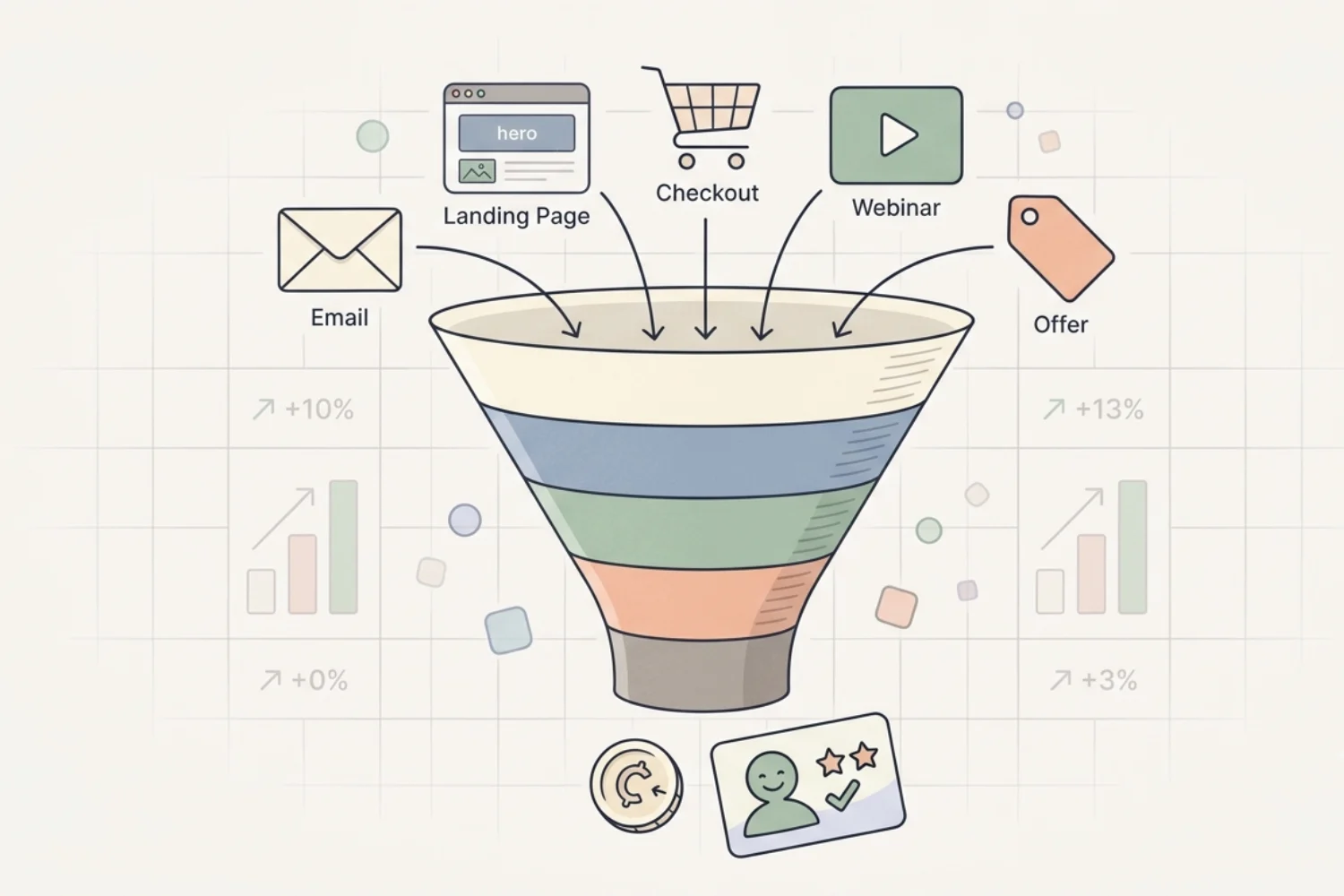
Building an email list is the beginning, not the destination. Turning a list into paying customers needs a system: a sales funnel capturing leads, nurturing them, and guiding them to purchase.
Here is the challenge. Dozens of sales funnel software platforms compete in 2026, each claiming to be the all-in-one solution for your business. Some cost $297 per month. Others are free but limited. Most review articles are affiliate promotions in disguise.
This guide cuts through the noise. We compared the best sales funnel software based on real features, current pricing, and honest pros and cons, so you choose the right tool for your specific needs and budget. If you are wondering how to build an email funnel without burning your runway on a six-figure stack, this comparison walks you through every option.
Table of Contents
What You’ll Learn
What is sales funnel software?
Sales funnel software helps you build the complete path from visitor to customer. Unlike simple email marketing tools sending emails alone, funnel software combines:
- Landing pages. Capture leads with optimized opt-in pages.
- Email sequences. Automate follow-up and nurture campaigns.
- Sales pages. Present your offer with high-converting designs.
- Checkout and payment. Process transactions and manage orders.
- Analytics. Track conversions at every stage.
Some tools handle all five. Others specialize in one or two areas and integrate with the rest of your stack.
Who needs sales funnel tools?
- Online course creators selling digital products
- E-commerce businesses recovering abandoned carts
- SaaS companies converting free trial users to paid
- Coaches and consultants selling high-ticket services
- Content creators monetizing their audience
- Small businesses building automated lead-to-sale systems
Quick comparison: best sales funnel software at a glance
| Tool | Best for | Starting price | Free plan? |
|---|---|---|---|
| ClickFunnels | All-in-one funnel building | $81 per month | No (14-day trial) |
| ThriveCart | One-time payment checkout | $495 lifetime | No |
| GetResponse | Email + funnel combo | $16 per month | Yes (limited) |
| Systeme.io | Budget-friendly all-in-one | Free / $27 per month | Yes |
| Kartra | Course creators and coaches | $119 per month | No (30-day trial) |
| Kit (ConvertKit) | Creator-focused funnels | Free / $25 per month | Yes |
| Leadpages | Landing page focused | $37 per month | No (14-day trial) |
| MailerLite | Email-first funnels | Free / $10 per month | Yes |
| HubSpot | Enterprise CRM + funnels | Free / $20 per month | Yes (limited) |
| Notion + Email Marketing Toolkit | DIY funnel planning | $0 to 15 (template) | Partial |
The 10 best sales funnel software in 2026
1. ClickFunnels: best all-in-one funnel builder
Starting price: $81 per month (Startup), $248 per month (Pro)
ClickFunnels practically invented the funnel builder category. It remains the most comprehensive all-in-one platform for building complete sales funnels, from landing page to checkout to follow-up.
Key features:
- Drag-and-drop funnel builder with pre-built templates
- Built-in email marketing and automation
- A/B testing on every page
- Membership site functionality
- Affiliate management system
- One-click upsells and order bumps
Pros:
- Most complete funnel-building solution available
- Huge template library and active community
- Built-in analytics and split testing
- Handles everything from landing page to payment
Cons:
- Expensive, especially for beginners ($81+ per month)
- Learning curve gets steep fast
- Page builder feels clunky compared to modern tools
- Limited email marketing compared to dedicated platforms
Best for: Established businesses needing a complete funnel system and ready to justify the investment.
2. ThriveCart: best lifetime deal for checkout funnels
Price: $495 one-time payment (lifetime access)
ThriveCart specializes in checkout pages and cart funnels. Its one-time pricing model makes it one of the most cost-effective long-term investments for businesses selling digital products.
Key features:
- High-converting checkout page templates
- One-click upsells and bump offers
- Subscription and payment plan management
- Affiliate management center
- A/B testing on checkout pages
- Integrations with all major email platforms
Pros:
- One-time payment (no recurring fees)
- Excellent checkout conversion rates
- Built-in affiliate management
- Handles taxes and compliance
Cons:
- No landing page builder (requires a separate tool)
- No built-in email marketing
- Limited design customization
- $495 upfront feels steep for new businesses
Best for: Digital product sellers wanting a strong checkout system without monthly fees.
3. GetResponse: best email and funnel combo
Starting price: Free (500 subs), $16 per month (Email Marketing), $54 per month (Marketing Automation)
GetResponse evolved from a pure email marketing tool into a solid funnel builder. Its Conversion Funnel feature lets you build complete funnels inside an email-first platform.
Key features:
- Pre-built conversion funnel templates
- Email marketing and automation
- Landing page builder
- Webinar hosting (unique feature)
- E-commerce integrations
- Website builder included
Pros:
- Affordable entry point with strong email features
- Webinar funnels (unique selling point)
- Good automation for the price
- Free plan available for testing
Cons:
- Funnel builder less robust than ClickFunnels
- Design options feel limited
- Advanced automation requires higher-tier plan
- Learning curve for webinar features
Best for: Businesses wanting email marketing and basic funnel building in one affordable platform.
4. Systeme.io: best free or budget option
Starting price: Free (up to 2,000 contacts), $27 per month (Startup)
Systeme.io is the underdog deserving more attention. Its free plan includes funnel building, email marketing, and even course hosting. Other platforms charge $100+ per month for the same features.
Key features:
- Sales funnel builder (up to 3 funnels on the free plan)
- Email marketing and automation
- Online course hosting
- Blog and website builder
- Membership site functionality
- Affiliate management
Pros:
- Incredibly generous free plan
- All-in-one platform at budget pricing
- Easy to learn and use
- No transaction fees on any plan
Cons:
- Fewer templates than ClickFunnels
- Limited design customization
- Smaller community and ecosystem
- Advanced features feel basic
Best for: Beginners and solopreneurs wanting an all-in-one platform without the premium price tag.
5. Kartra: best for course creators and coaches
Starting price: $119 per month (Starter)
Kartra positions itself as the all-in-one platform for knowledge commerce. It combines funnel building, email marketing, membership sites, and video hosting into one ecosystem.
Key features:
- Advanced funnel builder with behavioral triggers
- Email marketing with dynamic content
- Membership site and course hosting
- Video hosting with in-video CTAs
- Helpdesk and ticketing system
- Calendar and scheduling
Pros:
- Most complete platform for course creators
- Behavioral-based automation (advanced)
- Video hosting with marketing features
- All business tools in one dashboard
Cons:
- Expensive ($119 per month minimum)
- Feels overwhelming for beginners
- Interface looks dated compared to competitors
- Limited integrations outside the Kartra ecosystem
Best for: Course creators and coaches wanting everything in one platform and ready to invest.
6. Kit (ConvertKit): best creator-focused funnel tool
Starting price: Free (10,000 subs), $25 per month (Creator)
Kit is not traditional funnel software, but its email-first approach to funnels suits creators selling through content and relationships, not high-pressure sales pages. For a real creator email funnel, Kit hits the sweet spot of price, deliverability, and audience tooling.
Key features:
- Visual automation builder
- Landing pages and opt-in forms
- Email sequences with conditional logic
- Digital product sales (built-in commerce)
- Subscriber tagging and segmentation
- Creator Network for cross-promotion
Pros:
- Most generous free plan (10,000 subscribers)
- Built for audience-first businesses
- Built-in commerce for selling digital products
- Clean, intuitive interface
Cons:
- No traditional sales page builder
- Limited design options for emails
- No checkout optimization features
- Not ideal for complex multi-product funnels
Best for: Bloggers, podcasters, and creators building funnels through email sequences rather than landing pages. Pair Kit with Email subject lines Studio to lift open rates across every sequence.
7. Leadpages: best for landing-page-focused funnels
Starting price: $37 per month (Standard), $74 per month (Pro)
Leadpages specializes in one thing: high-converting landing pages. If your funnel strategy centers on capturing leads through optimized pages, Leadpages outperforms most all-in-one tools.
Key features:
- 200+ landing page templates
- Drag-and-drop builder with mobile optimization
- A/B testing built into every page
- Pop-ups and alert bars
- Leadmeter (AI-powered conversion predictions)
- Native integrations with email platforms
Pros:
- Best landing page builder on the market
- AI conversion predictions (Leadmeter)
- Excellent A/B testing
- Fast, mobile-optimized pages
Cons:
- No built-in email marketing
- No checkout or payment processing
- Requires integration with other tools for a full funnel
- Limited automation capabilities
Best for: Businesses focused on lead generation, already paired with email marketing and payment tools.
8. MailerLite: best email-first funnel builder
Starting price: Free (1,000 subs), $10 per month (Growing Business)
MailerLite is primarily an email marketing platform, but its automation, landing pages, and e-commerce features make it a capable funnel builder for businesses leading with email.
Key features:
- Email automation workflows
- Landing pages and pop-ups
- Digital product selling
- Website builder
- Subscriber segmentation
- A/B testing on emails and pages
Pros:
- Highly affordable (starts free)
- Clean, easy-to-use interface
- Strong email deliverability
- Includes landing pages on the free plan
Cons:
- Limited funnel visualization
- No built-in checkout optimization
- Basic compared to dedicated funnel tools
- Free plan includes MailerLite branding
Best for: Small businesses and solopreneurs wanting funnel capabilities inside an affordable email marketing tool.
9. HubSpot: best for enterprise and CRM-driven funnels
Starting price: Free CRM, $20 per month (Marketing Hub Starter)
HubSpot is the enterprise-grade option. Its CRM-driven approach to funnels means every interaction gets tracked, scored, and attributed, giving you complete visibility into the customer journey.
Key features:
- Full CRM with lead scoring
- Email marketing and automation
- Landing pages and forms
- Deal pipeline management
- Detailed attribution reporting
- 1,500+ integrations
Pros:
- Most comprehensive CRM integration
- Excellent analytics and attribution
- Scales from startup to enterprise
- Free CRM with generous features
Cons:
- Gets expensive at scale
- Complex setup for advanced features
- Marketing Hub required for full funnel features
- Overkill for simple product funnels
Best for: B2B companies, agencies, and growing businesses needing CRM-integrated funnel tracking.
10. Notion + Email Marketing Toolkit: best for DIY funnel planning
Price: Free (Notion) + $15 for the Email Marketing Toolkit template
Here is an unconventional but high-leverage approach: use Notion as your email marketing funnel template hub for planning and tracking, then connect it to any sending platform (MailerLite, Kit, Brevo). The toolkit treats every database (now called a data source in Notion) as a working layer of your funnel.
What the toolkit handles:
- Funnel mapping. Visual funnel structure with stages and email sequences.
- Email planning. Subject lines, content, CTAs, and send schedules.
- Performance tracking. Open rates, click-through rate, conversions per email.
- A/B test logging. Track which variations perform best.
- Campaign calendar. See every funnel and send in one timeline.
- Subscriber analytics. Monitor list growth and engagement.
Pros:
- Extremely affordable (one-time purchase)
- Works with any email sending platform
- Full customization in Notion
- Own your data (no vendor lock-in)
- Plan, write, and track in one workspace
Cons:
- Does not send emails (requires a separate platform)
- No built-in landing page builder
- Requires manual metric entry (or Notion API integration)
- Self-service setup
Best for: Marketers wanting a flexible, affordable funnel planning system on top of whatever sending platform they already use. Pair it with Affiliate Link Hub + UTM Builder and UTM Links Generator to attribute every click back to the funnel stage it came from.
→ Get the Email Marketing Toolkit
How to choose the right sales funnel software
Decision framework: match your situation
“I am starting out and have no budget.”
→ Systeme.io (free all-in-one) or Notion + Email Marketing Toolkit (plan free, send free with MailerLite or Kit)
“I sell digital products or courses.”
→ ThriveCart (one-time payment, best checkout) or Kartra (all-in-one for courses)
“I am a content creator building an audience.”
→ Kit (free for 10,000 subs) plus Email Marketing Toolkit for planning
“I need everything in one platform.”
→ ClickFunnels (most complete) or Systeme.io (budget-friendly)
“I already have email marketing sorted.”
→ Leadpages (landing pages) plus ThriveCart (checkout)
“I run a B2B company or agency.”
→ HubSpot (CRM-driven funnels with attribution)
The hybrid approach: best of both worlds
You do not have to pick one tool alone. Many successful marketers run a combination.
The budget stack (under $30 per month)
- MailerLite (free): email sending plus basic automation
- Email Marketing Toolkit ($15 one-time): funnel planning and tracking
- Canva (free): email and landing page graphics
The creator stack ($25 to 50 per month)
- Kit ($25 per month): email, commerce, landing pages
- Email Marketing Toolkit: complete funnel planning
- Email subject lines Studio: subject-line variations for split tests
- ThriveCart ($495 one-time): optimized checkout
The growth stack ($100 to 200 per month)
- ClickFunnels ($81 per month): complete funnel builder
- Email Marketing Toolkit: strategy and planning layer
- Affiliate Link Hub + UTM Builder: clean attribution on every link
- Zapier ($20 per month): connect everything
5 sales funnel best practices for 2026
1. Start simple, then expand
Your first funnel should run 5 to 7 emails maximum. A lead magnet, welcome sequence, and soft pitch beats a 20-email monster you never finish building.
2. Focus on one funnel at a time
Avoid building five funnels at once. Build one, get it converting, then replicate the winning formula.
3. Use AI for first drafts, not final copy
AI tools help draft email content fast, but always edit for your brand voice and add personal stories. Authentic communication converts better than polished AI copy.
4. Track everything, optimize monthly
Set up proper UTM tracking on every link. Review funnel metrics monthly. Small improvements compound: a 1 percent conversion lift across 5 stages creates exponential growth. The UTM Links Generator keeps your tags consistent across every campaign.
5. Plan your funnel before you build
Map your entire funnel inside the Email Marketing Toolkit before touching any platform. Knowing exactly what you are building saves hours of rebuilds.
Frequently Asked Questions
What is the best free sales funnel software?
Systeme.io offers the most complete free plan, including funnel building, email marketing, and course hosting for up to 2,000 contacts. For email-focused funnels, Kit’s free plan (10,000 subscribers) is hard to beat.
How much does sales funnel software cost?
Pricing ranges from $0 (Systeme.io free plan) to $248 per month (ClickFunnels Pro). Most mid-range options run $25 to $120 per month. ThriveCart offers a unique lifetime deal at $495.
Do I need dedicated funnel software or are email marketing tools enough?
It depends on your needs. If you sell primarily through email sequences, an email marketing platform (Kit, MailerLite) paired with the Email Marketing Toolkit for planning is sufficient. If you need complex landing pages, checkout optimization, and upsell funnels, dedicated funnel software (ClickFunnels, ThriveCart) is worth the investment.
How do I build a sales funnel in Notion?
Plan, organize, and track a sales funnel in Notion with the Email Marketing Toolkit. For sending emails and processing payments, connect a sending platform (MailerLite, Kit, Brevo) and a payment processor (Gumroad, ThriveCart, Stripe). Notion handles strategy through its data source and database layer. Other tools handle execution.
What is the difference between a sales funnel and a marketing funnel?
A marketing funnel covers the entire customer journey from first awareness to advocacy. A sales funnel focuses on the conversion stages: turning interested leads into paying customers. In email marketing, an email marketing sales funnel refers to the automated email sequences driving purchases.
Final picks by category
- Best all-in-one: ClickFunnels (if budget allows) or Systeme.io (if not)
- Best for creators: Kit + Email Marketing Toolkit
- Best checkout tool: ThriveCart (lifetime deal)
- Best email and funnel combo: GetResponse or MailerLite
- Best for enterprise: HubSpot
- Best for planning a creator email funnel: Notion + Email Marketing Toolkit, paired with Email subject lines Studio and UTM Links Generator
The best sales funnel software is the one you keep using consistently. Start with what fits your budget and needs today, and upgrade as your business grows.
Whatever platform you choose for sending, pair it with the Email Marketing Toolkit to plan your funnels strategically, track performance, and optimize for better conversions.